

Family Mediation in Peterborough
Family mediation is a voluntary process where a neutral, accredited mediator helps separating couples — married or common-law — reach agreement on parenting arrangements, child support, spousal support, and property, and turn those decisions into a separation agreement.
For Peterborough and Kawarthas families, mediation is almost always faster, dramatically less expensive, and more private than a contested court file — and it works whether you’re separating at 35 with young kids or at 65 with a retirement plan to untangle.
I’m Ken Maynard, an Accredited Family Mediator (OAFM) and Certified Divorce Financial Analyst, and I work with Peterborough-area couples both virtually and in person.

What It’s Like Working with Separating Couples in Peterborough
Peterborough separations have their own patterns, and after years of mediating files across the city and the Kawarthas, the same themes come up again and again.
More couples here separate later in life. Peterborough draws people who came for retirement or stayed after long careers — and it shows in my files. Later-life separation (what gets called “grey divorce”) is its own discipline: the questions aren’t about daycare, they’re about pensions already in pay, splitting CPP credits, whether the house sale funds two retirements or none, and what spousal support looks like when both incomes are fixed.
Two people who planned one retirement now need two — and that’s a financial-design problem before it’s a legal one, which is exactly why couples here work with a mediator who’s also a Certified Divorce Financial Analyst.
For working families, the math is about cash flow, not complexity. Most Peterborough files don’t involve holding companies or stock plans. The hard part is simpler and harsher: making two households work on income that barely ran one. Rent in Peterborough isn’t what it was, and a settlement that looks fair on paper can leave both of you house-poor.
My mediations start with the real budget — what each household actually costs — so support and property decisions are made against what’s livable, not just what’s calculable. It’s also why my process is priced the way it is: a separation shouldn’t consume the very savings you’re dividing.
The county is part of the file. Peterborough separations spread across real distance — one spouse in the city, the other in Lakefield, Millbrook, Buckhorn, or on a rural route past Norwood.
Distance shapes everything: parenting exchanges over winter county roads, school-bus catchments that constrain where each parent can live, and property that might include acreage, outbuildings, or a waterfront place that’s been in one family for two generations.
Rural property and family cottages raise valuation and ownership questions that deserve a financial analyst’s treatment, not a guess.
Everyone knows everyone. Peterborough is a city that works like a town — the same rinks, the same schools, the same employers. A courtroom fight becomes community knowledge; mediation is closed and confidential, and it ends with two people who can still stand next to each other at the arena. In a place this size, that matters for decades.
What Does Family Mediation in Peterborough Cover?
Family mediation covers every issue a separating couple needs to resolve. In my practice that means:
Our Peterborough Family Mediation Services are crafted to assist couples in resolving their disputes amicably and efficiently. We foster open and respectful communication between parties, guiding them toward mutually beneficial agreements without the need for costly and stressful court battles.
Our approach emphasizes reducing conflict, promoting cooperation, and ensuring all decisions are fair and equitable. Whether addressing child arrangements, property division, spousal support, or a Matrimonial Home Buyout, our experienced mediators are here to support you through every step of the process.
Peterborough Service Area — In Person and Virtual
I serve separating couples across Peterborough, the county, and the Kawarthas, including Lakefield, Bridgenorth, Millbrook, Norwood, Buckhorn, and Havelock, with in-person sessions available at my Peterborough-area meeting location and virtual sessions available region-wide — including when one spouse has already moved toward the GTA or further afield.
Most of my Peterborough-area clients choose Zoom video mediation, and out here the case makes itself: nobody drives in from Buckhorn for a 7 p.m. session in February, a parent can attend after bedtime from home, and when one of you has already relocated, video keeps the process moving without anyone on the 115 every week.
Breakout rooms let me caucus privately with each of you, and for higher-conflict couples the screen itself is a useful buffer. Virtual mediation is every bit as effective as meeting in person — and we can mix formats, holding early sessions by video and the signing-stage meetings face to face.
For more information: (705) 957-8016 · Toll Free 1.888.752.5819

Your Matrimonial Home and the Peterborough Real Estate Market
Your Matrimonial Home — When the House Is the Retirement Plan
In Peterborough separations the home carries a weight beyond its price, because for a large share of couples here it is the retirement plan. For later-life files the question is rarely “who keeps the house” — it’s “can either retirement survive one of us keeping it?”
Selling frees the capital that has to fund two futures; keeping it means one spouse holds an illiquid asset while the other needs income. There’s no universal right answer, but there is always an honest one, and it lives in the numbers.
For younger families the version is different but just as unforgiving: with modest equity and one income on the mortgage, can a buyout actually work — and if it can’t, what does selling and re-housing in this rental market really cost each of you?
Add the properties that make the Kawarthas the Kawarthas — acreage with outbuildings, a waterfront place, a cottage that’s been in one family for two generations and half the extended family still uses — and the ownership and valuation questions multiply.
As a Family Mediator and Certified Divorce Financial Analyst, I put every realistic path — sell and split, buyout, deferred sale, offsets against pensions — into actual dollars, tested against each household’s real budget, so the decision you make is fair, equitable, and one both of you can actually afford to live with.
Here are some key options to consider when determining the future of your matrimonial home during separation or divorce:
- Sell the home and divide the net proceeds between both parties:
A straightforward approach that involves selling the home and dividing the net proceeds between both parties. - One Party Buys Out the Other:
One spouse purchases the other’s share of the home, taking full ownership. - Defer the Sale:
Continue co-owning the home temporarily, often until children are older or another agreed-upon time. - Rent the Home:
Rent out the property and share the rental income until a future decision is made. - Nesting Arrangement:
Children stay home while parents alternate living there according to an agreed schedule, maintaining stability for the children. - Transfer Ownership:
Transfer ownership to one spouse as part of the property settlement, possibly offset by other assets. - Co-Ownership:
Maintain joint home ownership even after the separation, possibly as an investment property. - Legal Agreements:
Create legally binding agreements detailing the terms and conditions for handling the Matrimonial Home.

Financial Statement Preparation Form 13.1 & Form 13
As a Family Mediator and Certified Divorce Financial Analysts, We offer a Financial Settlements service designed to assist couples in reaching fair and comprehensive financial agreements. By having a neutral third-party expert prepare your financial statements, you gain several key benefits:
- Unbiased Evaluation: As a neutral expert, I evaluate assets, debts, income, and expenses without favoring either party, ensuring an impartial assessment of your financial situation.
- Comprehensive Analysis: My service helps you thoroughly understand all financial aspects, including both immediate and long-term needs. This comprehensive analysis fosters informed decision-making.
- Enhanced Clarity: By clearly outlining financial details, I provide clarity that reduces confusion and potential conflicts, making the settlement process smoother and more transparent.
- Security and Fairness: With an objective expert involved, you can trust that the developed settlement addresses the financial security of both parties, promoting fairness and equity.
- Reduced Stress: My involvement simplifies complex financial matters, alleviating the stress and emotional strain often associated with divorce proceedings.
- Efficiency: I aim to streamline the process, helping you reach a settlement in fewer meetings, saving time and reducing costs.
By choosing my Financial Settlements service, you ensure a balanced and secure financial future, facilitating a smoother transition through the separation process.

Property Division Services
For clients residing in Peterborough, Ontario, the Ontario Family Law Act guides property division during a separation. Dividing property can often be one of the most contentious aspects of a separation. Our Property Division Services aim to simplify this process by providing clear, unbiased guidance on equitably dividing assets and property.
Our mediators strive to expand financial possibilities by considering different perspectives and strategies that may have been previously overlooked. We work diligently to ensure both parties receive a fair settlement without needing a prolonged legal battle. It’s important to understand that, in the context of Family Law, property includes everything you own and all your debts, not just real estate.
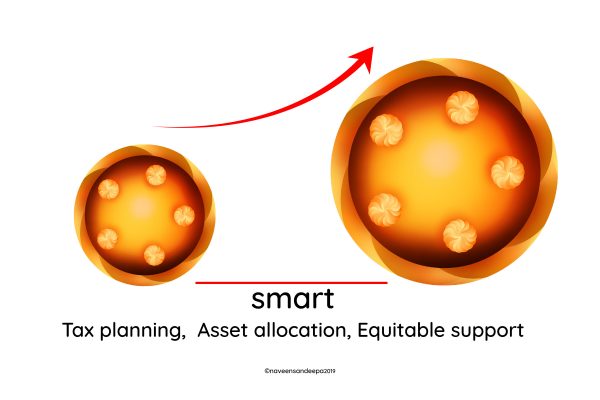
Spousal and Child Support Calculations
Child and spousal support calculations are a crucial part of your Separation Agreement. Determining the amount of support required can be complex, with many factors influencing what is appropriate.
Using state-of-the-art software and ensuring compliance with the Federal Child Support Guidelines, as well as interpreting the Spousal Support Advisory Guidelines, we can provide an accurate calculation that ensures the best possible future for your children and a fair outcome that addresses the needs of both parties.
Child Support Factors
Child support exists to make sure your children’s financial needs keep being met after separation — whatever changes for the two of you, their support shouldn’t.
The starting point is the table amount under the Federal Child Support Guidelines, driven by income and the parenting arrangement; on top of that sit section 7 special expenses — child care, rep sports and other extracurriculars, post-secondary — which get shared in proportion to income.
Where self-employment, a corporate structure, or variable earnings make the real income number less than obvious, I do the income-determination work first, as a neutral, so the support amount is built on what’s actually there.
The result is a fair, sustainable arrangement your children can rely on as the family’s structure changes around them.

Spousal Support Factors
Spousal support is about entitlement, amount, and duration — assessed under the Spousal Support Advisory Guidelines against the facts that actually drive the outcome: the length of the marriage, the roles each of you played, each spouse’s current financial position, and what each of you can realistically earn going forward.
Where the file calls for it, that includes compensatory claims after long single-earner marriages and security for support — insurance, review terms, protection if the payor’s income changes. As a CDFA, I model the options as scenarios — monthly vs. lump sum, different durations, different review structures — so you’re comparing sustainable outcomes in dollars, not adjectives, and the arrangement you choose respects both households’ real needs.

Co-Parenting in Peterborough
Co-parenting in Peterborough has to survive geography first. When one parent stays in the city and the other re-houses in Lakefield, Millbrook, or out past Buckhorn, the parenting schedule inherits twenty or forty minutes of county road — in January, in the dark, both ways.
A plan that works here gets built from the map: where the school and the bus route actually are, which parent can genuinely cover mornings and activity nights from where they’ll live, where exchanges happen when the roads are bad, and what the backup is when a shift runs late or Highway 28 doesn’t cooperate. School-bus catchments deserve special honesty — they quietly decide which houses are even possible for the parent who wants weekday time.
The second Peterborough reality is that you’ll keep seeing each other. Same rink, same school concerts, same grocery store — in a community this size, co-parents don’t get anonymity.
That’s a reason to build the plan for civility: exchanges designed so they don’t become scenes, sideline protocols for hockey and tournament weekends, an agreed way to handle the events you’ll both attend for the next decade, and section 7 cost-sharing for activities settled once instead of renegotiated every season.
The parents who do this well aren’t the ones who like each other most — they’re the ones who decided the details in advance.
Our goal is to help disappointed spouses transition to become awesome, great co-parents.
Effective co-parenting is crucial for the well-being of your children.
Our Co-Parenting Services provide guidance and support to help parents work together in raising their children post-separation.
We offer strategies and tools to improve communication, resolve conflicts, and create a stable and nurturing environment for your children.

Writing a Parenting Plan for Peterborough families
Crafting a comprehensive parenting plan can be challenging for separating or divorcing parents.
As your Family Mediator, a professional trained in conflict resolution and family law, we will guide you through this process and ensure that the parenting plan is thorough, balanced, and focused on the children’s best interests.
Rest assured, our Parenting Plan Service is designed to help you create an effective parenting plan in the most comprehensive way possible.
Here are the top 7 ways we ensure this:
Facilitating Open Communication:
Encourages honest and respectful discussions between parents.
It helps each parent express their concerns and preferences.
Identifying Key Issues:
Highlights essential topics like custody, visitation, education, and healthcare.
Ensures no critical aspect is overlooked.
Providing Expert Guidance:
Offers professional advice based on experience and knowledge of family law.
Suggests practical solutions tailored to the family’s unique situation.
Balancing Needs and Interests:
It helps parents find a fair balance between their individual needs and the best interests of their children.
Strives to create a plan that is equitable for both parties.
Drafting Clear Agreements:
Assists in writing clear, detailed, and legally sound agreements.
Ensures the parenting plan is comprehensive and unambiguous.
Managing Conflict:
It helps de-escalate tensions and resolve disagreements.
Teaches conflict resolution strategies that parents can use in the future.
Ensuring Flexibility and Adaptability:
Encourages the creation of a plan that can adapt to changing circumstances.
Includes provisions for future modifications if necessary.
Writing a Separation Agreement for Peterborough Couples
Our Separation Agreement service helps couples formalize the terms of their separation in a legally binding document. This agreement covers critical issues such as asset division, child custody and support, spousal support, and living arrangements. By clearly outlining these terms, we help prevent future disputes and provide a solid foundation for both parties moving forward.

Our Approach to Family Mediation for Separation and Divorce
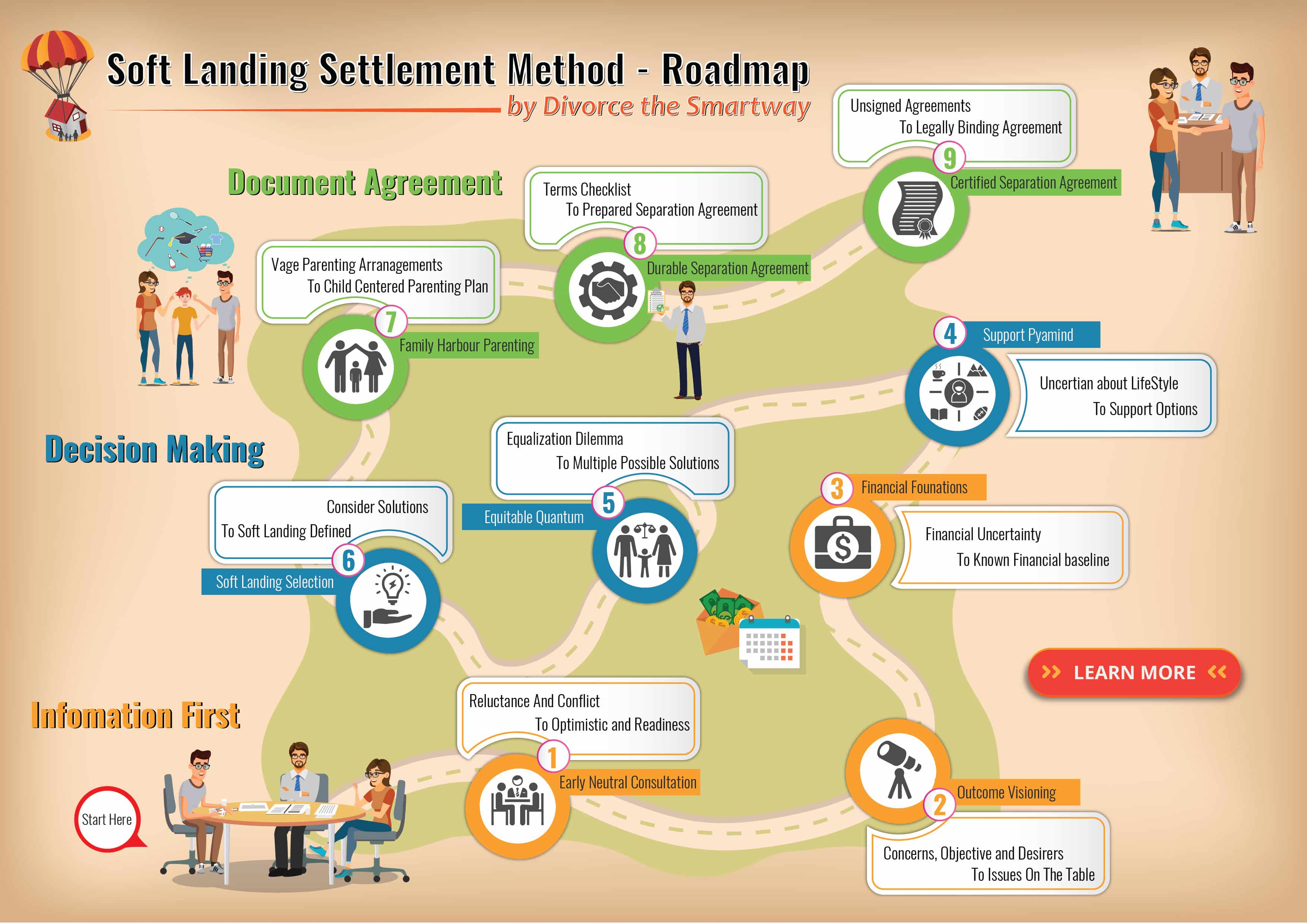
The Soft Landing Mediation for Separation and Divorce
Most separating couples don’t need a battle — they need a plan. The Soft Landing Mediation for Separation and Divorce is my structured approach to family mediation, built around a simple principle: information first, negotiation second. Before you and your spouse decide anything, you’ll both understand the complete financial picture and what each option actually means for your family — whether you’re building a parenting plan, working out support, or dividing property.
From there, I guide you through interest-based negotiation, step by step, toward a fair and amicable resolution — one that lands as a comprehensive divorce settlement or separation agreement your own lawyers can confirm before you sign. For Peterborough families, where the stakes on the home and the numbers on support are rarely simple, a soft landing isn’t about avoiding hard conversations. It’s about having them once, in the right order, with the right information on the table.
Click Image to enlarge Infographic
Fees: We use a hybrid fee structure: flat fees for defined deliverables — preparing your financial statements, drafting the parenting plan, drafting the separation agreement — and an hourly rate of $160 to $250 for mediation sessions, typically shared between spouses. A complete mediation runs about $6,000 for most working families, up to around $12,000 for more complex or higher-net-worth situations — total, for both of you, from first meeting to draft agreement.
Compare that with the retainer many family lawyers require from each spouse just to open a file, before a single issue is resolved. You’ll get exact numbers, in writing, on the Get Acquainted Call — before you commit to anything.
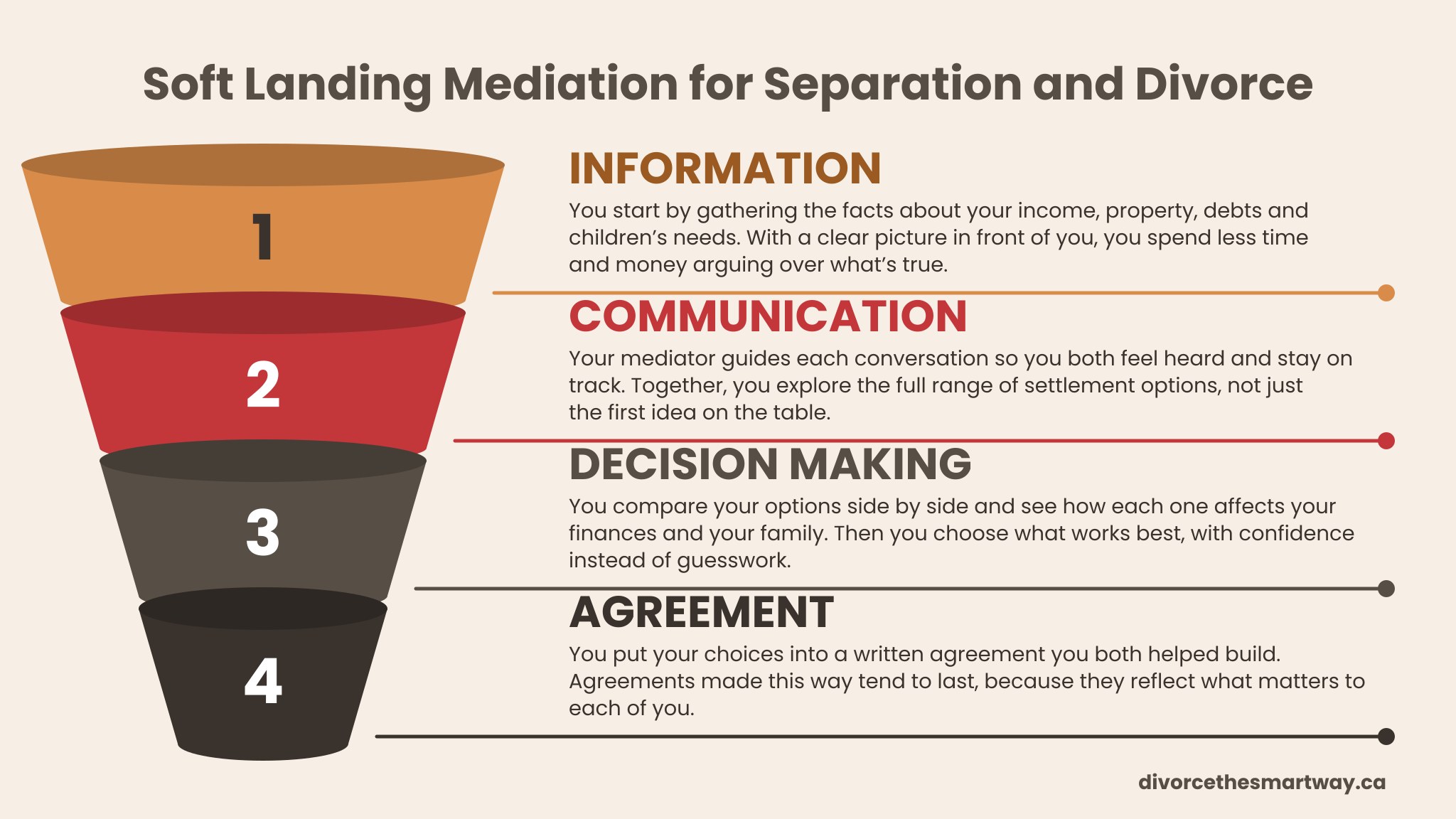
The Information First Model
The Information First Model from DTSW Mediation Services ensures a smooth and efficient separation process for couples. By starting with comprehensive client discussions, we understand your goals and concerns, acting as your intermediary.
Our method includes clear financial disclosures using our online tools, followed by a thorough financial walkthrough to ensure fair asset and liability division. This structured approach fosters effective communication and informed decision-making, helping couples achieve equitable settlements and secure futures.
Click Image to enlarge Infographic
11 Key Takeaways about Peterborough Mediation
- Soft Landing Mediation for Separation and Divorce: A unique approach designed to minimize conflict and ensure a smooth transition for families.
- Mediation Services: Facilitates open communication to reach mutually beneficial agreements without court battles.
- Property Division: Simplifies the process of dividing assets fairly and equitably.
- Family Mediation: Reduces stress and conflict through efficient, amicable solutions.
- Legal Separation: Helps couples reach fair and amicable agreements, ensuring legal requirements are met.
- Separation Agreements: Formalizes terms of separation, covering key issues like asset division and child custody.
- Child Support: Ensures fair and appropriate support amounts based on income and needs.
- Parenting Plans: Develops comprehensive plans for shared responsibilities and decision-making.
- Zoom Mediations: Offers convenient online mediation sessions.
- Spousal Support: Determines fair support arrangements based on various factors.
- Financial Settlements: Helps couples reach fair financial agreements for clarity and security.
For more information or to schedule a Get Acquainted Call,
Discover how our Soft Landing Mediation for Separation and Divorce can save you money and secure a brighter future with Divorce the Smartway.
For more information: (705) 957-8016 · Toll Free 1.888.752.5819
Get Acquainted Call
Do you want a Soft Landing?
Have a few questions?
Learn More:
Schedule a 15-Minute Complimentary Call
The mediation process itself isn’t binding. No one can impose an outcome on you. But the separation agreement that comes out of mediation is a legally binding domestic contract once it’s signed with independent legal advice and proper financial disclosure. That’s the whole point: you reach the decisions voluntarily, then formalize them enforceably.
You don’t need to be friendly. You need to be willing. Mediation is built for people in conflict; that’s why it exists. Screening, individual intake, structured agendas, and caucusing (meeting separately) let me mediate effectively even when direct conversation between you has broken down. What mediation can’t overcome is bad faith: hidden assets or refusal to participate.
I’m a neutral: I work for both of you and the quality of the agreement, not for one side. A lawyer advocates for one spouse only. The two roles are complementary, not competing: I help you build the agreement; your own lawyers each confirm, through independent legal advice, that it protects you before you sign.
Nothing you’ve lost. Mediation in my practice is a closed (confidential, without-prejudice) process: offers and discussions can’t be used against you in court later. If you resolve eight issues out of ten, your lawyers argue about two issues instead of ten. The process narrows conflict even when it doesn’t end it. In practice, the large majority of couples who complete the process reach full agreement.
The process is the same; the questions are different, and they’re mostly financial. Later-life separation turns on retirement income: pensions already in pay and whether they’re shared, CPP credit splitting, whether the house sale funds two retirements, what support means when both incomes are fixed, and updating the beneficiary and estate arrangements a long marriage leaves behind. There’s less time to recover from a bad settlement at 62 than at 38, which is why the financial-analysis side of my practice matters most in exactly these files. Adult children may not need a parenting plan, but they notice how their parents part. Mediation tends to leave that relationship intact too.
For modest-asset files, mediation isn’t just worth it. It’s the only economically sane option. Two litigation retainers can exceed the assets being divided; that’s not a settlement, it’s liquidation. My hybrid structure keeps costs proportional: flat fees for the defined pieces, hourly only for the sessions you actually need, shared between you, and a focused file with straightforward finances lands at the low end of the range. The Get Acquainted Call is free, and pricing comes in writing before you commit a dollar.
Mostly the history, and it matters everywhere. Assets each of you brought into the marriage affect the equalization math through date-of-marriage deductions, so documenting what existed on the wedding day is step one. Support you already pay to a prior family shapes what’s affordable in this one. And where stepchildren are involved, support questions can extend to a spouse who stood in a parental role, a fact-specific issue worth targeted legal advice. None of it is unusual; all of it rewards doing the financial homework before negotiating, which is exactly how my process is built.
First, the house gets valued twice (as-is and as-completed) because the gap between those numbers, minus the real cost to finish, is what you’re actually deciding about. Then the paths get priced: sell mid-project and split (someone buys your unfinished vision at a discount), one spouse takes the house and the completion risk in a buyout, or finish together under a written agreement covering who funds what, how contributions are repaid, and the sale timeline. Renovation debts and genuine sweat equity go into the math openly. There’s no universally right answer, but there’s always an honestly priced one.
Often, genuinely, yes. Two grid incomes mean disclosure is clean and support math is stable; two pension entitlements frequently offset rather than fight; mirrored benefits simplify the details. The file’s real work concentrates on the parenting plan and the home, which is exactly what mediation is best at. Symmetrical public-service files are routinely among the fastest and least expensive I complete, and they rarely have any business being in a courtroom.
No. And avoiding court is rather the point. A separation agreement reached in mediation and signed with independent legal advice is a binding domestic contract without a judge ever seeing your names. Court remains available if mediation genuinely fails, but the large majority of couples who complete the process reach full agreement, married and common-law alike.
Yes. Plenty of couples come to me for parenting-only mediation, a support recalculation after a job change, or to resolve a single sticking point their lawyers couldn’t move. You don’t have to sign up for a full-scope process to get value from mediation.
No. Family mediation serves married and common-law couples alike. The parenting and support frameworks are essentially the same for both; property rules differ significantly (equalization applies to married spouses, while common-law property claims work differently), and I’ll make sure both of you understand which regime applies to you.
Virtual Family Mediation
Zoom Video Family Mediation stands out as a unique and effective method for facilitating divorce mediation, offering a host of features that set it apart from traditional in-person mediation:
Accessibility
- Convenience and Flexibility: With Zoom Video Family Mediation, couples can participate from the comfort of their homes, eliminating the need for travel and allowing for more flexibility in scheduling, a significant advantage for those with busy schedules.
- Geographical Reach: It enables mediation for couples where both parties may not reside in Peterborough, or may live far apart in different locations, including cities or countries.
Efficiency
- Time-Saving: Virtual meetings can be scheduled more frequently, often leading to a faster resolution of issues.
- Cost-Effective: Zoom Video Divorce Mediation can be more affordable, as it eliminates the need for physical office space, travel expenses, and related costs, a significant benefit for those looking to manage their finances during the divorce process.
Comfort and Neutrality
- Neutral Environment: Both parties may feel more at ease in their own space, which can reduce stress and facilitate more productive discussions.
- Private and Secure: Zoom Video Family Mediation provides secure, private meeting rooms where discussions can occur without interruption. This ensures a safe and confidential environment, giving both parties the peace of mind they need during this sensitive process.
Enhanced Communication
- Technology Integration: The real-time sharing of screens, documents, and other resources enhances the mediation process.
- Recording Sessions: With both parties’ consent, sessions can be recorded for later review, ensuring clarity and transparency.
Flexibility and Adaptability
- Customizable Sessions: Mediators can tailor sessions to the specific needs of the couple, whether that involves shorter, more frequent meetings or longer, in-depth discussions.
- Use of Breakout Rooms: Zoom’s breakout room feature allows mediators to have private discussions with each party, similar to in-person caucusing.
Psychological Comfort
- Reduced Confrontation: Virtual mediation with Zoom can significantly lessen the confrontation in face-to-face meetings, helping to keep emotions in check and providing a sense of relief during this challenging time.
- Less Formal: The informal setting of a home environment can make the process feel less intimidating, promoting openness and cooperation.
Overall Effectiveness
- High Satisfaction Rates: Many couples report high levels of satisfaction with the process and outcomes of virtual mediation.
- Successful Outcomes: Zoom mediation is as effective as traditional in-person mediation in reaching agreements and resolving disputes.
In summary, Zoom Video Family Mediation offers a practical, efficient, and effective alternative to traditional in-person mediation. It provides numerous benefits that cater to the needs and circumstances of modern divorcing couples.


Ken S. Maynard
- APFM - Association of Private Family Mediators Canada
- CDFA - Certified Divorce Financial Analyst
- Member, Association of Family and Conciliation Courts (AFCC)
- Member, Family Dispute Resolution Institute of Ontario (FDRIO)
I help intelligent, successful couples move through separation without getting pulled into the adversarial legal system. Together we craft a custom separation agreement that sets you up for a secure future and a smooth transition to the next chapter.
Many couples reach a complete agreement in about four meetings. Others need more time, and that's fine. The pace is set by your situation, not by a formula. Either way, you sidestep most of the conflict, confusion, and cost that come with going through the courts.
You can work with me by video conference or meet in person with a DTSW associate at any of our six Greater Toronto mediation centres in Aurora, Barrie, North York, Vaughan, Mississauga, and Scarborough.