

How to Start Mediation in Ontario: Your First Steps
A plain guide to suggesting mediation, choosing a mediator, what to bring and what happens at your first session.
Last reviewed: October 20, 2026 by Ken S. Maynard, AP.fm, CDFA
To start mediation in Ontario, you and your spouse both agree to try it, you choose a family mediator, and each of you meets the mediator privately for an intake and screening meeting. Then you gather your financial documents and sit down together to work through parenting, support and property, one issue at a time.
If you’re wondering how to start mediation when you haven’t even raised it with your spouse yet, you’re not alone. This guide walks you through each step, from that first conversation to signing your separation agreement. It also includes a checklist of what to bring, so your first session is spent making decisions instead of hunting for paperwork.
Who agrees
Both spouses, freely
First step
A free call with a mediator
Typical cost
$2,140 to $7,060 per couple, plus HST
Who decides
The two of you, not a judge
How to start mediation in 8 steps
Most couples follow the same path. Some steps take a day and others take a few weeks, mostly depending on how quickly you gather documents.
- Check that mediation is safe for you. Mediation works when both of you can speak freely. If you’re afraid of your spouse, tell the mediator before anything else.
- Suggest mediation to your spouse. Keep it short and calm, and give them time to look into it on their own.
- Choose a family mediator. Look for an accredited family mediator who works mainly with separating couples in Ontario.
- Book a free first call. A short call lets you ask about fees, timing and how the mediator works before you commit.
- Sign an agreement to mediate. This contract sets out the ground rules, the fees and whether your mediation is open or closed.
- Meet the mediator separately for intake and screening. Each of you talks privately with the mediator about your situation, your goals and any safety concerns.
- Gather your documents and meet together. You exchange financial information, then work through parenting, support and property in joint sessions.
- Get legal advice and sign. The mediator writes up what you agreed, and each of you has your own lawyer review it before you sign.
Is mediation right for your family?
Family mediation is a process where a trained, neutral person helps you and your spouse reach your own agreement about separating. The mediator doesn’t take sides, make decisions or give legal advice. The two of you make every decision.
Mediation is voluntary in practice. Ontario’s family mediation guidance says you need to be willing to try to work things out with the other person. Under Ontario’s Family Law Rules, a judge can send an issue to mediation only if you both consent. The one exception is a parenting order under the federal Divorce Act, which can direct parents to attend a family dispute resolution process such as mediation.
The Divorce Act also says that, where it’s appropriate, separating spouses shall try to resolve their issues through a process like mediation, negotiation or collaborative law. Family lawyers must encourage their clients to try these options, unless it’s clearly not appropriate. If you haven’t separated yet, our guide on how to separate in Ontario covers the steps that come first.
When mediation isn’t safe
Mediation isn’t right for everyone. If there’s been violence or threats, or your spouse controls the money or watches your phone, it can be hard to say no in the same room, even with a mediator present. That’s why accredited family mediators screen each person privately before joint sessions start, and keep watching for safety concerns throughout.
Ask yourself a few honest questions before you begin:
- Have I ever feared for my safety, or my children’s safety, because of my spouse?
- Does my spouse control the money so I can’t see or use it?
- Would I find it hard to say no to my spouse, even with a mediator there?
- Has my spouse threatened to take the children if I leave or disagree?
A yes doesn’t mean mediation is impossible. It means you tell the mediator and your lawyer first. Safeguards such as separate rooms, separate video calls or lawyers attending can help. Sometimes another process is the safer choice, and a good mediator will tell you so.
How to suggest mediation to your spouse
This is where many people get stuck. One of the most common questions I hear is how to propose divorce mediation without starting another argument. The goal is simple: make it easy for your spouse to say yes on their own terms.
Don’t be a mediation cheerleader
People are more likely to consider an idea when they feel free to choose it. Tell your spouse you’re open to working out a fair settlement and that you’d like to try mediation. Then stop. Pushing, repeating or arguing the case usually backfires.
Pick your moment and your method
Timing matters. New ideas raised in the middle of an argument are rarely well received. If a face-to-face talk is hard right now, a short, calm email works well. You might simply share a link to a mediation website and ask your spouse to think about it.
Give them time to do their own research. A website, a brochure or a suggestion from someone you both trust helps them feel informed instead of pressured. Then agree on a time to talk again.
Send a ground rules template
One approach that works well is to attach our free Mediation Ground Rules and Intentions template to your email. In separation, fear can take over clear thinking. The template tells your spouse three things without you having to say them out loud: you’re not here to fight, you value them as a parent if you have children, and you want a fair, respectful separation.
Why the first move matters
I know this from my own life. Years ago, before I became a mediator, I received a letter from my spouse’s lawyer and was instantly overwhelmed. From that point on, fear did my thinking for me, and it led to three years of lawyers and family court. I don’t want that for you. It’s a big part of why I became a mediator.
What if my spouse says no?
If your spouse says no, or won’t answer, don’t treat it as final. Many people say no at first because they feel rushed or suspicious, or they’re simply not ready. Give it a few weeks. In the meantime, you can book a call with a mediator yourself to understand the process, or ask a lawyer to suggest mediation on your behalf.
If your spouse still won’t take part, you aren’t stuck. Your other options are covered further down. While you wait, a BIFF response (brief, informative, friendly and firm) can keep tense messages from turning into fights.
Not sure how to raise mediation with your spouse?
In a free call, we’ll talk through how to suggest it and what happens next.
How to choose a family mediator
The right mediator makes a big difference to how the process feels and how much it costs. Look for someone who works mainly with separating couples and holds formal family mediation training and accreditation.
Where to find a mediator
Ontario’s family mediation page points to three places to search for a private mediator: the Ontario Association for Family Mediation, Family Mediation Canada and the ADR Institute of Ontario. Our guide to choosing a family mediator in Ontario goes deeper. For my part, I’m an accredited family mediator, a Certified Divorce Financial Analyst (CDFA) and a member of the Family Dispute Resolution Institute of Ontario (FDRIO).
Private or court-connected mediation
You have two main choices. Private mediators set their own fees, and you can start as soon as you’re both ready. Ontario also funds family mediation service providers at family courts across the province.
Court-connected mediation is free on the day your case is in court. Off-site mediation through these providers is charged on a sliding scale based on income and number of dependants. For example, Ontario’s page says someone earning under $60,000 a year pays between $5 and $105 an hour. Providers can also reduce or waive fees.
| Private mediation with DTSW | Court-connected mediation | |
|---|---|---|
| When you can start | As soon as you’re both ready | Through the mediation provider at your family court |
| Cost | $2,140 to $7,060 per couple, plus HST, usually shared | Free on your court day; sliding scale off-site |
| Where you meet | By video, or in person at six GTA centres | At or near the courthouse |
| Money help | Settlement analysis by a CDFA | Varies by provider |
| Who decides | The two of you | The two of you |
Questions to ask a mediator before you hire them
- What is your hourly rate, and what will the first stage cost?
- What family mediation training and accreditation do you have?
- How do you screen for safety and power imbalances?
- Do you help with the money side, such as support, pensions and dividing property?
- Will our mediation be open or closed?
- Who writes up our agreement, and when do our lawyers see it?
If you can’t get straight answers about cost and process, keep looking.

Template
Set intentions and ground rules
A template for agreeing how you’ll work together before mediation starts.
Get the templateFree. Your link arrives by email in a minute.
What happens at your first mediation session
Your first step with a mediator is usually a separate intake meeting for each of you. Ontario’s guidance describes it as intake and screening: the mediator meets each person privately to make sure you can both negotiate on an equal footing.
The agreement to mediate
Before joint sessions begin, you both sign an agreement to mediate. It covers the mediator’s role, the fees, confidentiality and how the process will run. It’s also where you choose open or closed mediation.
Open or closed mediation
In closed mediation, what you say and the documents you share stay confidential and can’t be used in court. In open mediation, the mediator can prepare a report that may be shared with a court. Ontario’s guidance says mediation is closed unless you both agree it should be open. Most couples choose closed mediation so they can speak freely.
Your first joint session
At the first joint meeting, the mediator sets ground rules, confirms the issues you need to decide and helps you agree on an order to tackle them. Most couples start with what’s most urgent, often the children’s schedule or who pays which bills right now. The issues usually include parenting time, decision-making, child support, spousal support and dividing property. You won’t solve everything on day one, and you don’t need to.
Your mediation checklist: what to bring
Coming prepared saves time and money. Mediation moves faster when both of you are looking at the same numbers, and full financial disclosure is what makes your final agreement solid.
Financial documents
- Your last three years of tax returns and Notices of Assessment
- Recent pay stubs or other proof of income
- Bank, investment, RRSP and TFSA statements
- Pension statements
- Mortgage, loan, line of credit and credit card statements
- Property tax assessments or appraisals, and vehicle ownership
- Any marriage contract, cohabitation agreement or existing court order
Ontario’s court forms include a sworn financial statement: Form 13 is used when only support is claimed, and Form 13.1 when property or the matrimonial home is involved. Even outside court, many mediators use them as a template. Our guide to Form 13 and Form 13.1 explains which one fits, and our page on financial disclosure in Ontario covers what to include.
Parenting
- Your children’s current schedule, school and activities
- A note of special expenses, such as child care, sports or medical costs
- Any ideas you already have for a parenting plan
If you have children, you’ll work out a parenting plan that covers parenting time and decision-making responsibility, along with child support.
Your goals and priorities
Write down what matters most to you and why. Separate your needs from your wants. Then think about what your spouse cares about. Mediation works best when each of you understands the other’s interests, not just their positions.
If you’d like to see where you stand before you start, our free Divorce Financial Readiness Indicator gives you a quick score and shows what to work on first.

Ask us a question
Have a question about your situation?
Send it to us and we’ll reply within one business day. No call needed, and there’s no obligation.
Ask your questionWe reply Monday to Friday. Questions sent on a weekend or holiday get an answer the next business day.

How to prepare yourself for mediation
Documents are only half of it. The other half is how you show up.
- Listen to understand, not to reply
- Use “I” statements to say what you need without blaming
- Focus on the future, not old arguments
- Ask for a break if emotions run high
- Get support from a counsellor or a friend outside the sessions
What not to say in mediation
Avoid personal attacks, ultimatums and digging up the past. Lines like “you’ll never see the kids” or “take it or leave it” shut down progress fast. Say what you need and why, then listen to the answer.
Don’t overlook the money side
In my practice, I often see couples about to sign a deal that looks equal today but won’t feel equal in five years. A house, a pension and an RRSP with the same dollar value aren’t worth the same after tax. As a Certified Divorce Financial Analyst, I can run a settlement analysis so each of you sees what the terms mean for your cash flow and retirement before you sign.
What happens after you reach an agreement
When you’ve settled every issue, the mediator writes a summary of what you agreed, often called a memorandum of understanding. That summary is then turned into a separation agreement.
Before you sign, each of you takes the agreement to your own lawyer for independent legal advice. A mediator is neutral and can’t advise either of you on your rights, so this step protects you both. At DTSW, we send the agreement directly to each spouse’s lawyer.
In Ontario, a separation agreement is a domestic contract. Under the Family Law Act, it must be in writing, signed by both of you and witnessed to be enforceable. It doesn’t need a judge’s approval to be legally binding. A divorce is a separate court application, and a signed agreement makes it much simpler.
What if mediation doesn’t work?
Sometimes mediation settles some issues but not all, or one spouse stops taking part. You still have options:
- Collaborative law, where each of you hires a lawyer who agrees to settle without going to court
- Arbitration, where a neutral arbitrator hears both sides and makes a binding decision
- Court, where a judge decides the issues you can’t agree on
If you do go to court, most family cases require each person to attend a Mandatory Information Program session early on. Anything you already settled in mediation can still go into a written agreement, which narrows what’s left to argue about. And if your mediation was closed, what you said stays confidential.
How long mediation takes and what it costs
Many couples settle in about four meetings. Others take longer, especially when there’s a business, a pension to value or a lot of conflict. The pace is mostly up to you, including how fast you gather documents.
At DTSW, mediation typically costs $2,140 to $7,060 per couple, plus HST, and the cost is usually shared. Senior mediators charge $250 an hour, which is $125 per spouse, and associates charge $160 to $190 an hour, all plus HST. We also work on a sliding scale, so some families pay less. Each spouse’s independent legal advice is a separate cost. Our page on how much mediation costs in Ontario breaks it down further.
Mediation by video or in person across Ontario
You don’t have to live near us to start mediation. I work with couples by video across Ontario, including London, Oshawa and Hamilton. If you’d rather meet in person, a DTSW associate can see you at one of six Greater Toronto mediation centres: Aurora, Barrie, North York, Vaughan, Mississauga and Scarborough.
If you want to go deeper on choosing a process, Chapter 4 of my book, Nobody Lands Softly by Accident, compares the four ways to reach an agreement: the kitchen table, mediation, collaborative law and court.
Reading keeps you informed. Talking helps you feel better.
If you’ve read everything and still don’t know your next step, let’s talk it through in a free, no-pressure call.
Frequently asked questions about starting mediation
Can I be forced to go to mediation in Ontario?
Generally no, because an Ontario judge can refer you to mediation only with consent, though a Divorce Act parenting order can direct it
Mediation is voluntary in practice, so it depends on both people being willing to try. Under the Family Law Rules, a judge can refer an issue to dispute resolution only on consent. A parenting order under the Divorce Act can, however, direct parents to attend a family dispute resolution process.
The Divorce Act also expects spouses to try these processes where it’s appropriate. If safety is a concern, mediation may not be appropriate at all.
Who pays for mediation?
Spouses usually share the cost of mediation, though you can agree to split it another way
Most couples split the mediator’s fees evenly. Some split them in proportion to income, or have one spouse pay and adjust for it in the final agreement. Each spouse pays their own lawyer for independent legal advice.
What are the steps in mediation?
Mediation moves through intake, an agreement to mediate, sharing information, negotiating and a written agreement each lawyer reviews
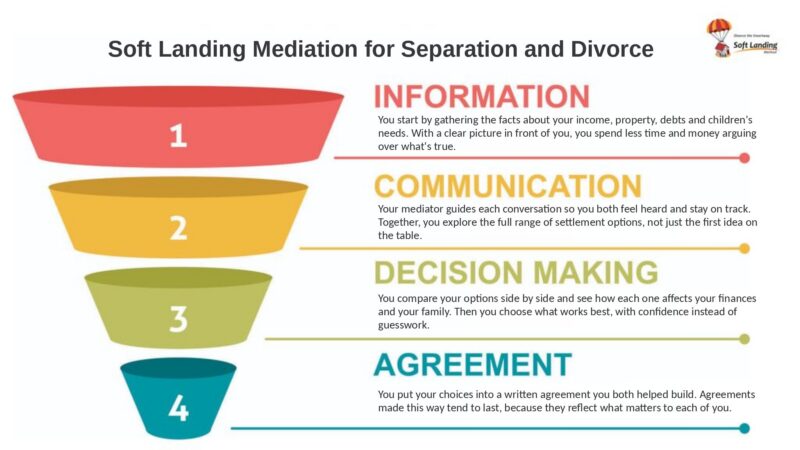
Some guides list five steps and others seven, but the stages are the same. You start with separate intake and screening meetings, sign an agreement to mediate and exchange financial information. Then you work through each issue in joint sessions. Finally, the mediator writes up what you agreed, and each of you gets independent legal advice before signing.
What should I not say in mediation?
Avoid threats, ultimatums, personal attacks and old grievances, because they push your spouse to defend instead of negotiate
Comments about the past or about your spouse’s character rarely move anything forward. Focus on what you need, why you need it and what you can offer in return. If you feel yourself getting angry, ask for a short break.
Is a mediated agreement legally binding in Ontario?
Yes, once it becomes a written separation agreement that you both sign in front of a witness
What you agree to in mediation becomes binding when it’s turned into a separation agreement that meets the Family Law Act: in writing, signed by both of you and witnessed. A court doesn’t need to approve it. Getting independent legal advice before you sign helps show that you both understood what you agreed to.
What is the downside of mediation?
Mediation only works if both spouses disclose honestly and can negotiate safely, and a mediator can’t force anyone to cooperate
A mediator can’t order anyone to hand over documents or follow through. If one spouse hides money, stalls or is controlling, mediation can stall too, and court or arbitration may be needed. For most couples who can talk with help, though, mediation is faster, cheaper and more private than court. Our page on the advantages and disadvantages of mediation weighs them up.
Do we each need a lawyer if we use a mediator?
Yes, each spouse should get independent legal advice from their own lawyer before signing a separation agreement
The mediator stays neutral and doesn’t give legal advice. Your own lawyer explains your rights and checks that the agreement works for you. You can also talk to a lawyer during mediation if a question comes up.
Is mediation confidential?
Closed mediation is confidential, so what you say can’t be used in court, unless you both agree to open mediation
Ontario’s guidance says mediation is closed unless both people agree otherwise. In open mediation, the mediator can write a report that may be shared with a court. Your mediator will explain any limits on confidentiality, such as a concern about a child’s safety, at the start.
Reading gets you informed. Talking to someone helps you feel better.
“You said you’ve read everything. Has any of it made you feel better?”
Rob, in Nobody Lands Softly by Accident
A Get Acquainted Call is a free, no-pressure conversation about where you are and what your next step could be. Choose phone or video.
Book a Get Acquainted Call
Ken S. Maynard
- APFM - Association of Private Family Mediators Canada
- CDFA - Certified Divorce Financial Analyst
- Member, Association of Family and Conciliation Courts (AFCC)
- Member, Family Dispute Resolution Institute of Ontario (FDRIO)
I help intelligent, successful couples move through separation without getting pulled into the adversarial legal system. Together we craft a custom separation agreement that sets you up for a secure future and a smooth transition to the next chapter.
Many couples reach a complete agreement in about four meetings. Others need more time, and that's fine. The pace is set by your situation, not by a formula. Either way, you sidestep most of the conflict, confusion, and cost that come with going through the courts.
You can work with me by video conference or meet in person with a DTSW associate at any of our six Greater Toronto mediation centres in Aurora, Barrie, North York, Vaughan, Mississauga, and Scarborough.