
We own the house and a rental, and we can’t carry the mortgages apart
Two properties, two mortgages and two households to run. Here’s how Ontario treats the rental, and the options couples use.
By Ken S. Maynard, AP.fm, CDFA, Certified Divorce Financial Analyst and family mediator. Last reviewed: November 21, 2026
When you own a home and a rental property and separate in Ontario, the rental is usually counted in your equalization like any other asset, but the real problem is cash flow: two mortgages that one income can’t carry. Couples usually sell, buy each other out, take one property each, or keep owning together for a while.
Start by working out what each property is worth after its mortgage and after the tax waiting inside it. Then check what each of you can carry on your own income before you agree to any split.
Is this you?
This page fits if most of these sound like your situation:
- You and your spouse own the home you live in and at least one rental or investment property.
- Both properties have mortgages, and the payments only worked on two incomes.
- One of you wants to keep a property, but you’re not sure a lender will approve you alone.
- Selling the rental would mean a tax bill neither of you has budgeted for.
- There are tenants in the rental, and nobody is sure who should collect the rent now.
A home plus a rental with heavy mortgages is a common situation in my practice. It’s the kind of file where the Soft Landing Method turns up a range of settlement options.

Scorecard
How ready are your finances for separation?
Answer a few questions and see where you stand, and what to sort out first.
Get your scoreWhat usually happens in Ontario
For married spouses, Ontario divides the value you built during the marriage through equalization, not the properties themselves. Equalization means each spouse adds up their net family property (what they own minus what they owe on the separation date, less what they brought into the marriage), and the spouse with more pays the other half the difference. That rule is in Part I of Ontario’s Family Law Act. For the general rules on every kind of asset, see our guide to division of assets in an Ontario divorce.
Does the rental count as family property?
Yes. A rental or investment property goes into the owner’s net family property at its value on the valuation date, minus its mortgage. The valuation date is usually the day you separated with no reasonable chance of getting back together.
The rental is treated differently from your home in two ways. It isn’t a matrimonial home unless your family ordinarily lived in it when you separated (section 18). And if one of you owned the rental before the wedding, that spouse deducts its net value on the wedding day; only the growth during the marriage is shared. The home you lived in gets no such deduction. A rental you received as a gift or inheritance from someone else during the marriage can be left out entirely, if you can trace it.
Common-law partners are outside these rules. Equalization doesn’t apply to them, so the property generally stays with whoever is on title, unless a partner proves a claim such as unjust enrichment. If you were common-law and both of you are on title, each of you owns your share, and either can apply to court for a sale under Ontario’s Partition Act if you can’t agree.
Can one of you carry two mortgages alone?
Often not. Two mortgages, property tax, insurance, repairs and the odd empty month were planned on two incomes. Separate, and the same costs land on one paycheque each.
Of the 28 people who left a comment on our readiness check between August 2025 and November 2026, 7 were worried about credit in their own name and qualifying for a mortgage or refinance alone. Of the 64 people who completed it from 2024 to November 2026, 35 said they expect to borrow after separation.
Three lender facts shape every option:
- If both names are on a mortgage, the lender can usually collect the whole balance from either of you. Your separation agreement binds the two of you, not the bank.
- Getting your name off a joint mortgage usually takes the lender’s written release, a refinance in the other spouse’s name or a payout on sale. Confirm with your lender.
- Lenders can still count rental income when you qualify. In November 2025 Canada’s banking regulator, OSFI, said its underwriting rules still allow rental income, including for owners of more than one property. Each lender decides how much of the rent it counts.
What tax is waiting inside the rental?
A rental usually carries tax you haven’t paid yet, and the tax moves with the property. Ontario’s Family Law Act counts these “contingent tax liabilities” when net family property is worked out (section 4(1.1)), so a fair split looks at after-tax value. Our guide to the tax implications of divorce covers the wider picture.
- Capital gains: when a rental is sold, the gain is taxable. The inclusion rate for 2025 is 50%, which means half the gain is added to income. The planned increase to two-thirds was cancelled in March 2025.
- Recapture: if you claimed depreciation on the building (capital cost allowance, or CCA), selling for more than its remaining tax value means the CRA treats the difference as recaptured CCA, reported as rental income.
- Transfer to a spouse: under section 73 of the federal Income Tax Act, moving a property to a spouse, or to a former spouse in settlement of your marriage rights, usually rolls over at its tax cost. The tax is put off, not erased, and the transferor can choose not to use the rollover.
- Land transfer tax: Ontario exempts transfers between spouses or former spouses made under a written separation agreement, a court order, or where the only payment is taking over a registered mortgage.
Couples with several properties face the same tax at a larger scale; our high net worth separation guide walks through it. Check the numbers for your own properties with an accountant.
Who pays and who collects while you’re separated?
With a rental property during divorce or separation, someone still has to pay both mortgages and collect the rent until you settle. Put a short written plan in place early. It should say who collects the rent and tells the tenants where to pay it, who pays each mortgage, the property tax and insurance, who approves repairs, and how unequal payments get credited when you settle. Both owners usually stay liable for the costs, whoever is paying them. Ask your accountant how the rent and expenses should be reported for tax while the plan runs.
If one of you lives in the home and the other doesn’t, the question of occupation rent can come up too.
Tenants keep their rights through all of this. Under Ontario’s Residential Tenancies Act, a sale doesn’t end a tenancy by itself. If the buyer wants to move in, the seller can give notice only in specific cases (for example a building with three units or fewer), with at least 60 days’ notice, and must pay the tenant one month’s rent or offer another unit the tenant accepts (sections 49 and 49.1).
What are the usual ways out?
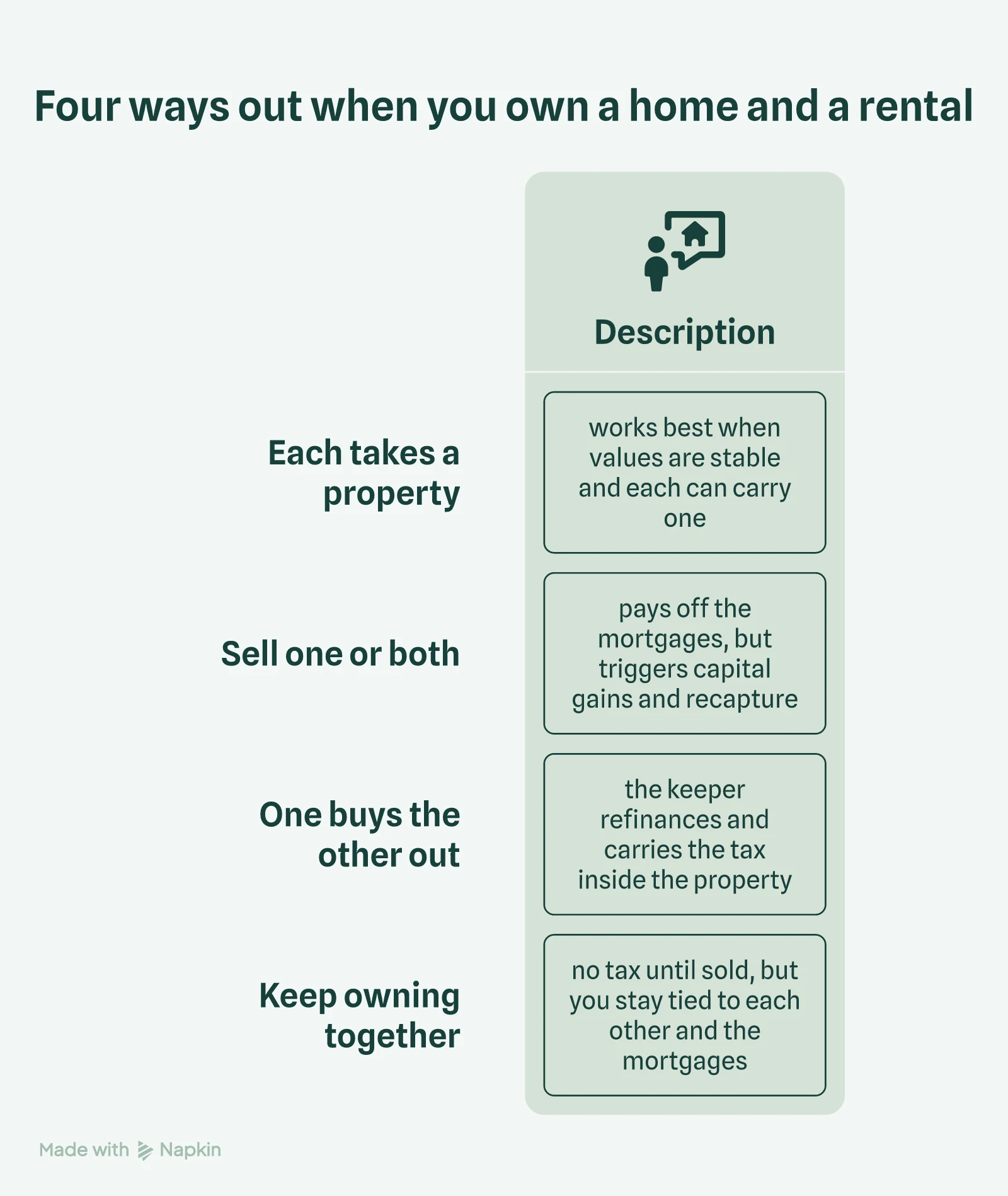
Couples usually land on one of four options. The right one depends on cash flow and tax more than on equity:
| Each takes a property | Sell one or both | One buys the other out | Keep owning together | |
|---|---|---|---|---|
| Mortgages | One each, if each lender approves | Paid off from the sale | Keeper refinances, often both | Stay joint |
| Tax now | Often none if section 73 applies | Capital gains and recapture on sale | Depends on how the buyout is paid | None until sold |
| Tax later | Each keeps the tax inside their property | Settled at the sale | Keeper carries it | Shared at a later sale |
| Works best when | Values are stable and each can carry one | Neither can carry a property alone | One has the income to qualify | You trust each other’s follow-through |
| Watch for | Two properties rarely have equal after-tax value | Selling costs and tenant notice rules | Paying half the equity before tax | Continuing ties and joint liability |
If one property is worth more after tax than the other, the difference goes into the equalization payment, paid in cash or from other assets. A court can also let a payment be made in instalments, or delayed, for up to 10 years where that’s needed to avoid hardship (section 9). If you need a court to decide equalization, the deadline is the earliest of two years after the divorce or six years after you separated (section 7(3)).
The first decision to make
Before anyone picks a property, look at your whole financial picture, then decide whether each of you can carry the property you’d keep on your own income. That answer rules options in or out.
- Look at the whole financial picture. On the affordability problem, I find couples are often overly focused on the real estate line items and not the overall financial picture. List everything each of you owns and owes, not just the two properties, because other assets can come into play to reach a settlement.
- Value each property. Start with full financial disclosure from both of you, then get the value and mortgage balance for the home and the rental on your separation date, and the wedding-day value of anything owned before the marriage.
- Work out the net rent. Take the rent and subtract the mortgage payment, property tax, insurance, repairs and a vacancy allowance. That’s the cash the rental adds or costs each month.
- Estimate the tax inside each property. Ask an accountant for the capital gain and any recapture if each property were sold today.
- Talk to a lender, each of you. Ask whether you’d qualify to keep a property alone, how much rent they’d count, and whether they’d release the other spouse.
For the family home, the buyout calculator below gives you a first figure.

Calculator
What would it cost to buy out your spouse?
Work out a buyout figure for the family home and get a report emailed to you.
Work out a buyoutA real story: each of them took a property
Composite example, based on one of our files, with identifying details left out.
A couple came to us owning their home and a rental. We went through many options together, with a cash flow analysis and a capital gains analysis for each one.
In the end they decided that each spouse would take one property. They also agreed what would happen next: after some time, each of them would look at whether keeping their home met the needs of their new life, and then decide to keep it or sell.
How we help
I’m a Certified Divorce Financial Analyst and accredited family mediator, and I’ve mediated separations in Ontario since 2010. Before I started mediating, I owned a real estate consultancy firm from 1988 to 2001. I worked for many private and institutional owners and acted on over 338 real estate properties. That’s the background I draw on when a couple owns more than one property and the mortgages don’t fit two households.
The Soft Landing Method looks at all of your assets, not only the real estate. A pension, RRSPs, savings or investments can sometimes offset a property in the settlement, so neither of you has to carry both mortgages.
When speed matters, I often find it’s better to divide the ownership on an after-tax basis and sell later. It works best when property values are stable. It’s one of several options I build, and we test each one before you choose.
You can work with us in two ways:
- In Soft Landing Mediation for Separation and Divorce, I act as a neutral mediator and Certified Divorce Financial Analyst for both of you, so the cash flow and tax analysis happens in the room.
- If one of you wants the numbers tested on your own, our settlement analysis shows what each option is worth after tax and over time.
You meet with me by video, or in person with a DTSW associate at one of six Greater Toronto mediation centres. I don’t give legal advice: your draft agreement goes to each of your own lawyers for independent legal advice before you sign.

Not sure which property each of you could carry?
We’ll look at your two properties, the mortgages and the tax, and tell you which options are worth testing.
Rental property in a separation: common questions
What happens to a rental property in a divorce in Ontario?
For married spouses, its value minus the mortgage goes into the owner’s net family property, and the growth during the marriage is shared through equalization
You don’t have to split the property itself. One of you can keep it and pay the other in another way, you can sell it, or you can each take a different property. Unpaid tax inside the rental counts when the value is worked out.
How do you divide a rental property in a divorce?
Compare each option on an after-tax basis, then sell, buy out, swap properties or keep owning together under a written plan
Splitting the equity 50/50 can leave the spouse who keeps the rental paying the whole tax bill later. Look at the capital gain, any recaptured depreciation and the selling costs before you agree on a buyout figure.
Is a rental property part of the matrimonial home?
Not unless your family ordinarily lived in it as your family residence when you separated
A property can be a matrimonial home only if you lived in it as a family at separation (Family Law Act, section 18). The difference shows up in the numbers: a rental owned before the wedding keeps its date-of-marriage deduction, and a matrimonial home doesn’t.
Do I pay capital gains tax if I transfer the rental to my spouse?
Usually not at transfer, because a spousal rollover moves it at its tax cost and puts the tax off until a sale
The rollover under section 73 of the Income Tax Act also covers a former spouse when the transfer settles rights from your marriage. The transferor can choose not to use it, which can trigger tax now. Get tax advice on your own figures.
Can I get off the joint mortgage on our rental?
Yes, but usually only with the lender’s written release, a refinance in your spouse’s name, or a payout when the property sells
A separation agreement that says your spouse will pay the mortgage doesn’t change your contract with the lender. Until you’re released, missed payments can still affect your credit.
Can one of us refinance using the rental income?
Often yes, lenders can count rental income when you qualify, but each lender decides how much of the rent it counts
OSFI confirmed in November 2025 that its underwriting rules still let lenders use rental income, including for owners of more than one property. Ask each lender for its own calculation before you build a settlement around it.
Can other assets help us keep a property?
Often yes, other assets such as a pension, RRSPs, savings or investments can offset a property so one spouse isn’t left carrying both mortgages
How each asset is counted is covered in our guide to division of assets in an Ontario divorce.
Who collects the rent and pays the mortgage while we’re separated?
Whoever you agree on in writing, with a plan for how unequal payments get credited when you settle
Both owners usually stay liable for the mortgages and the property costs until you settle. A short written plan avoids arguments with each other and with the tenants.
What happens to the tenants if we sell the rental?
The tenancy usually continues with the buyer, and a buyer who wants to move in must follow Ontario’s notice and compensation rules
The seller can give notice for a buyer’s own use only in specific cases, with at least 60 days’ notice and one month’s rent or another acceptable unit as compensation. Build the timing into your plan if you’re selling.

Ask us a question
Have a question about your situation?
Send it to us and we’ll reply within one business day. No call needed, and there’s no obligation.
Ask your questionWe reply Monday to Friday. Questions sent on a weekend or holiday get an answer the next business day.
Want a first look at the numbers before you call? Try our home buyout calculator for the family home.
Reading keeps you informed. Talking helps you feel better.
If you’ve read everything and still don’t know your next step, let’s talk it through in a complimentary, no-pressure call.