
Is Divorce With Mediation Worth It? 9 Reasons Ontario Couples Say Yes

If you are separating in Ontario, you have two fundamentally different paths in front of you: litigate your divorce through the Family Court system, or resolve it through divorce with mediation. One path involves lawyers, court filings, motions, affidavits, and months (often years) of waiting. The other involves you, your spouse, and a neutral certified divorce mediator working through the same issues — parenting, property division, child support, and spousal support — around a table instead of in front of a judge.
So, is divorce with mediation worth it? For the vast majority of separating couples in Ontario, the answer is an emphatic yes. Mediation typically costs a fraction of litigation, moves at your pace rather than the court’s, and produces a legally binding Separation Agreement that both of you actually helped design — which is exactly why people tend to honour it.
This guide walks through the nine biggest reasons Ontario couples choose divorce with mediation, compares mediation to litigation side by side, covers costs, and answers the questions we hear most often.
Have questions about your situation? Book a complimentary 15-minute Get Acquainted Call and get real answers before you make any decisions.
Get Acquainted Call

Professional Divorce Mediation Services in Ontario - Marriage Separation Mediators
Here are nine reasons Ontario couples consistently tell us mediation was worth it
What Is Divorce With Mediation?
Divorce with mediation is a voluntary alternative dispute resolution process. Instead of each spouse hiring a lawyer to fight for them, both spouses work with a single neutral professional — a certified divorce mediator — who guides them through every issue that needs to be resolved before a divorce can be finalized:
Parenting time and decision-making responsibility, child support, spousal support, division of property and debts, and the equalization of net family property under Ontario law. Once you reach agreement on these issues, the terms are set out in a Separation Agreement — a legally binding contract. No court process or court appearance is necessary to get there.
The mediator does not take sides and does not impose decisions. They ask the tough questions, keep the conversation respectful and productive, and steadily move both of you toward understanding and settlement. Legal advice stays with lawyers (each spouse should still get independent legal advice before signing); settlement negotiation is the mediator’s craft
| Divorce With Mediation | Litigated Divorce | |
|---|---|---|
| Who decides the outcome | You and your spouse | A judge |
| Timeline | Typically weeks to a few months | Often 1–3+ years in Ontario’s backlogged Family Court |
| Cost structure | One neutral professional, usually shared | Two lawyers billing hourly, each side pays their own |
| Court appearances | None required | Multiple — case conferences, motions, possibly trial |
| Privacy | Confidential process | Court filings become part of the public record |
| Tone | Cooperative, structured, respectful | Adversarial by design |
| Flexibility | Agreements tailored to your family | Standardized orders within the court’s constraints |
| Compliance | High — you built the agreement | Lower — imposed terms invite resistance |
| Co-parenting relationship | Often preserved or improved | Frequently damaged |
9 Reasons Divorce With Mediation in Ontario Is Worth It
1. You Never Have to Set Foot in a Courtroom
For many people, the fear of appearing before a judge ranks right up there with the fear of public speaking. The good news: with divorce mediation as your resolution method, that fear becomes irrelevant. You and your spouse agree on the terms of your separation, those terms are captured in a Separation Agreement, and the entire matter is resolved without a single court appearance. The courtroom simply never enters the picture.
2. You Skip Ontario’s Family Court Backlog Entirely
Ontario’s Family Court system is stretched thin. The province has been pressing the federal government for more judges to meet overwhelming demand, and the resources available to the Family Law Branch of the Ontario Superior Court keep getting thinner. Add a rising tide of self-represented litigants, and litigating your divorce today can feel less like a dignified legal proceeding and more like a long afternoon at Service Ontario.
Ask yourself honestly: how much time does a harried judge, working through a crushing docket, really have to contemplate the future of your family? In mediation, you take all the time you need. Sessions are scheduled around your life, not the court’s calendar, and the process moves as quickly as the two of you can reach agreement.
3. It Costs Dramatically Less Than Litigation
This is the reason that gets most people’s attention — and rightly so. When both spouses lawyer up, legal fees compound quickly. Even if you hire the most virtuous lawyer you can find, the other side might retain a barracuda, and your legal bills will be astounding. Contested family litigation in Ontario routinely runs into the tens of thousands of dollars per spouse, and high-conflict files can consume far more.
Divorce with mediation replaces two adversarial legal teams with one neutral professional whose fee is typically shared between the spouses and whose entire job is to get you to a settlement in a handful of sessions. The money you don’t spend on a courtroom fight stays where it belongs — funding two households, your children’s future, and a more comfortable retirement.
4. You Keep Control of the Decisions That Shape Your Family
Who is better positioned to design the future of your family: you, or a stranger in a robe? When a court imposes a “solution,” it’s simply human nature to start scheming against it. A litigated divorce may specify a court-ordered pick-up and delivery schedule, but life means change — what sounded right in May no longer works in December.
Mediation puts the pen in your hands. You and your spouse craft the parenting plan, the support arrangements, and the property division, and you build in the flexibility to handle the changes that inevitably come. Taking control of your own settlement isn’t just more dignified — it produces agreements that actually fit your life.
5. Agreements People Build Together Are Agreements People Keep
Here is one of the most underappreciated advantages of mediation: compliance. When conditions are imposed from outside, reluctant cooperation and “unintentional” foot-dragging follow — a formula for ongoing friction and misery, even when it never rises to the level that would justify dragging the other person back to court.
Mediation is voluntary from start to finish. People who work together to create plans they willingly agree upon are invested in those plans. The research and the lived experience both point the same way: there is a much higher likelihood that mediated agreements will be honoured, and that the parties will experience less conflict in the years that follow.
6. It’s Better for Your Children
When Canada updated the Divorce Act in March 2021, one of the driving reasons was the well-documented benefit that family dispute resolution brings to children. Kids gain from witnessing their parents cooperating rather than fighting. Mediation keeps both parents’ attention fixed on what is best for the children instead of on winning, and it models exactly the kind of problem-solving children need to see during a destabilizing time.
An adversarial process, by contrast, tends to entrench parents in opposing camps at precisely the moment their children need them working as a team
7. You Build Communication Skills That Last Long After the Divorce
One of the foremost payoffs of mediation is one nobody expects going in: the communication skills you develop at the table. Learning how to “get to yes” with your former spouse is a talent, and like any talent it develops through practice.
Couples who go through mediation — who spend real time reasoning with one another under a mediator’s guidance — consistently find there’s a carry-over effect. Future disagreements about schedules, expenses, or school decisions get resolved more easily because you’ve already learned how to negotiate with each other productively. Many clients tell us they had never experienced this sort of genuine give-and-take with their partner before mediation. For co-parents who will be in each other’s lives for decades, that skill set is worth its weight in gold.
8. The Overwhelming Majority of Cases Settle Anyway — So Start Where You’ll Finish
9. Canada’s Divorce Act Now Expects You to Try It
This isn’t just our opinion — it’s federal law. The March 2021 amendments to Canada’s Divorce Act added Section 7.3, which states:
“To the extent that it is appropriate to do so, the parties to a proceeding shall try to resolve the matters that may be the subject of an order under this Act through a family dispute resolution process.”
Parliament changed the law because dispute resolution through mediation is typically quicker and more cost-effective than taking family disputes to court, with particular benefits in cases involving children. If the law that governs divorce in Canada is directing families toward mediation first, that tells you something about how strongly the case for mediation has been made
If mediation fails, couples may need to pursue court litigation or collaborative divorce.
Unresolved issues after mediation may require legal intervention, but it’s rare for mediation to completely break down without some form of agreement (Divorce the Smartway).
Table of Contents
How Much Does Divorce With Mediation Cost in Ontario?
Because most people searching for answers are ultimately weighing cost, let’s address it directly. A contested, litigated divorce in Ontario commonly costs each spouse tens of thousands of dollars, with lengthy, high-conflict files climbing well beyond that. Those fees are paid separately, by each side, to professionals whose adversarial roles can prolong the conflict.
Divorce with mediation flips that structure. You engage one neutral professional, the cost is typically shared, and the process is designed to conclude in a defined number of sessions rather than an open-ended fight. For most couples, the total investment in mediation amounts to a small fraction of what even a moderately contested litigation would cost — often the difference between funding a legal battle and funding your post-divorce life.
When you factor in the speed, the reduced stress, and the durability of the agreement, the question “is divorce with mediation worth it?” tends to answer itself.
The Soft Landing Difference
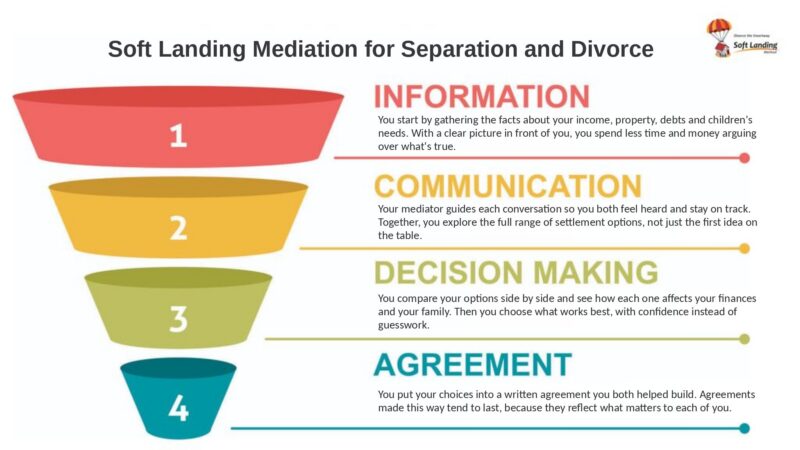
At DTSW, our divorce mediation process is known as The Soft Landing Mediation for Separation and Divorce — a structured, step-by-step approach that combines certified family mediation with professional divorce financial analysis. Clients consistently tell us the structure is what makes the difference: instead of circling the same arguments, you move through a defined process that addresses parenting, support, property, and financial disclosure in the right order, with the financial expertise built in rather than bolted on.
The result is what the name promises: a soft landing for both spouses and, most importantly, for your children.
You may hear that mediation isn’t a good fit where there has been family violence, or where a substantial power imbalance exists between spouses — and that in those situations, judicial processes may be preferable. The Divorce Act itself acknowledges this by requiring dispute resolution only “to the extent that it is appropriate to do so.”
That conventional wisdom deserves a closer look, because it quietly ignores what the alternative actually involves.
Let’s be clear: family violence is never acceptable, full stop. But modern mediation practice has evolved well beyond two people sitting across a table. With mediation conducted by remote video conference, spouses never need to be in the same room — or even the same city. Paired with a carefully constructed safety plan and thorough screening before the process begins, remote mediation allows for a safe, structured process in many situations that would once have been sent straight to court. And a trained mediator is specifically equipped to recognize and manage a substantial power imbalance — controlling the pace, structuring the communication, and ensuring the quieter voice at the table is genuinely heard.
Now consider the alternative. Can you imagine being locked into a one-to-three-year legal process with an abuser — inside a court system that has a reputation for not managing these kinds of personalities well? Litigation hands a controlling spouse a fresh arena: motions, delays, cross-examinations, and years of forced engagement, all at staggering financial and emotional cost. For many people, the drawn-out court process prolongs exactly the dynamic they are trying to escape.
A qualified mediator will always screen for family violence and power imbalance before mediation begins, and will tell you candidly if your circumstances truly call for a different path. But for a great many couples — including some who assumed they were “disqualified” — mediation, properly structured, offers the safer, saner, and smarter route through divorce.
Reading gets you informed. Talking to someone helps you feel better.
“You said you’ve read everything. Has any of it made you feel better?”
Rob, in Nobody Lands Softly by Accident
A Get Acquainted Call is a free, no-pressure conversation about where you are and what your next step could be. Choose phone or video.

Ken S. Maynard
- APFM - Association of Private Family Mediators Canada
- CDFA - Certified Divorce Financial Analyst
- Member, Association of Family and Conciliation Courts (AFCC)
- Member, Family Dispute Resolution Institute of Ontario (FDRIO)
I help intelligent, successful couples move through separation without getting pulled into the adversarial legal system. Together we craft a custom separation agreement that sets you up for a secure future and a smooth transition to the next chapter.
Many couples reach a complete agreement in about four meetings. Others need more time, and that's fine. The pace is set by your situation, not by a formula. Either way, you sidestep most of the conflict, confusion, and cost that come with going through the courts.
You can work with me by video conference or meet in person with a DTSW associate at any of our six Greater Toronto mediation centres in Aurora, Barrie, North York, Vaughan, Mississauga, and Scarborough.