


Broke by 36, With the House in Her Name
Two small kids, a house and an offer that looked generous. Here’s what it did to her savings, and what fixed it.
Last reviewed: October 26, 2026 by Ken S. Maynard, AP.fm, CDFA
The Joneses’ first offer gave her the family home and three years of support. On my projections, it also left her with no spendable savings by age 36. A few changes to who kept what turned that around, and it didn’t cost him a dollar of net worth.
A note on the numbers. This case study is about 15 years old, so the dollar amounts may seem very low. A home with $90,000 of equity, an $80,000 salary and $1,245 a month in child support were the figures of the day. Home prices, incomes and support amounts have all gone up a lot since. The pattern hasn’t changed, and that’s why I still use this case.
Jones isn’t the family’s real name, and I’ve changed details so no one can be identified.
The couple
Early 30s, married 6 years, kids 5 and 1
The offer
She keeps the house, he keeps the business
The problem
Her spendable savings gone by 36
What worked
Sell the house, move into the rental
Meet the Joneses
They were in their early 30s and had been married six years. Both had lawyers, and both wanted to avoid a long fight over money.
He earned about $80,000 a year. She was three years from finishing a degree, and after that she expected to earn about $36,000. The two children, aged 5 and 1, would live mainly with her. Child support on his income came to $1,245 a month, dropping to $774 once the older child reached the age of majority.
If she stayed in the family home, her costs for herself and the kids came to $4,995 a month, tuition included.
Here’s what they owned and owed:
- The family home: $90,000 of equity, with $130,000 left on the mortgage
- A rental property: $33,700 of equity, with $100,000 owing
- His small business: worth $201,000 after tax
- Her RRSP: worth $14,450 after tax
- Credit card debt: $22,600
The offer from his side
His lawyer drafted an offer that, to be fair, sounded pretty generous. Here’s what it said:
- She and the children stay in the family home, and the title moves to her name
- The rental property is sold, and she keeps the net proceeds
- She keeps her RRSP and takes over the credit card debt
- He keeps his business
- He pays support of $2,000 a month for the first year, then $1,500 a month for two more years while she finishes her degree
- He takes out a line of credit to pay her the $44,725 balance of the equalization payment (the amount that evens out what each of you gained during the marriage)
What the offer did to her
Her net worth chart didn’t look too bad. His line (green) climbed faster than hers (blue), but on paper she was okay.
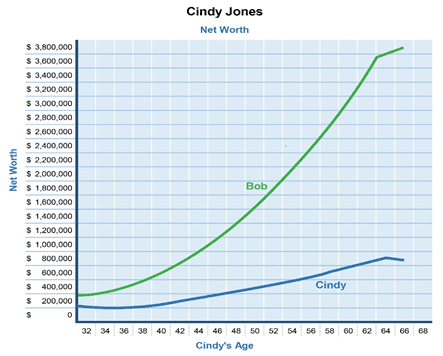
Then I looked at her working capital, the money she could actually spend. That’s where the trouble showed up.
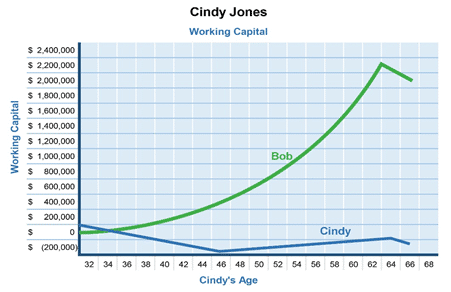
In year one her costs beat her income by $19,504. She started with $76,425 of working capital, and by year three only $2,485 was left. After that she’d have to start pulling money out of her RRSP. By 36, everything she could spend was gone.
And she’d still own the house. She just couldn’t afford to live in it.
Holding an offer that looks fine on paper?
A short call will tell us whether running your numbers forward is worth doing.
The revised proposal
Her lawyer and I worked on a counter-offer. Most of the assets stayed where they were. What changed was where she’d live and who carried the debt.
- The family home is sold, and she keeps the sale proceeds
- She and the children move into the rental property
- She keeps her RRSP
- He pays spousal support of $2,000 a month for three years, indexed each year
- He keeps his business and takes over the credit card debt
- The equalization payment is paid to her in yearly instalments, so he doesn’t need a line of credit
Why the rental? Her expected income wasn’t enough to carry the family home’s mortgage on her own. The rental’s smaller mortgage was.
Taking on the credit card debt lowered what he owed her in equalization. Paying the rest in yearly instalments meant no line of credit and no extra interest for him. (A court can do something similar: Ontario’s Family Law Act lets a judge spread an equalization payment over up to 10 years when paying it all at once would cause hardship.)
What changed for both of them
His net worth didn’t change. Hers went up a lot.
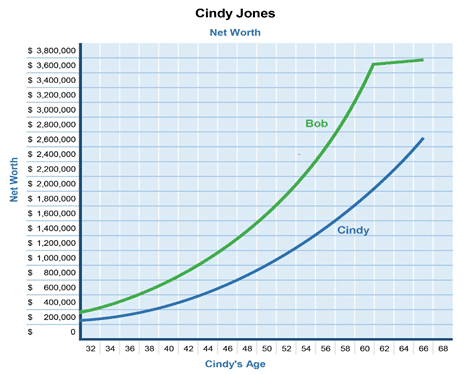
Moving into the rental cut her costs to $30,050 a year, down from $4,995 a month in the family home. Her mortgage payments went down too. The higher support and the money from the house sale gave her working capital that held up.
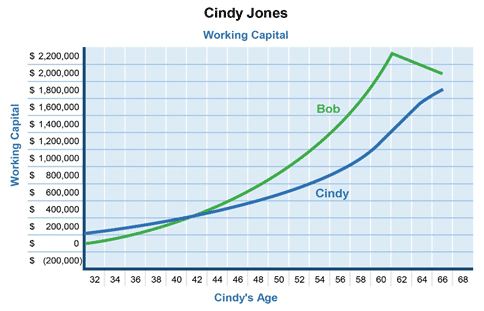
Best of all, she never had to touch her RRSP to pay the bills. Left alone, it’s projected to grow past $230,000 by the time she retires. His working capital barely moved from the first offer. Both of them came out able to stand on their own.
| Revised proposal | First offer | |
|---|---|---|
| Family home | Sold, she keeps the proceeds | She keeps it and lives there |
| Where she lives | The rental property | The family home |
| Support | $2,000 a month for 3 years, indexed | $2,000 a month for 1 year, then $1,500 for 2 |
| Credit card debt | He takes it on | She takes it on |
| Equalization | Yearly instalments, no line of credit | $44,725 balance through his line of credit |
| Her savings | RRSP grows past $230,000 by retirement | Spendable money gone by 36 |
What the Jones case teaches
Working capital tells you more than net worth. Her net worth looked fine. Her spending money ran out in three years.
The house can cost more than it gives back. Keeping it felt safe. Selling it and moving into the rental is what protected her retirement savings.
Who carries the debt changes the math. Moving the credit card balance to him lowered the equalization and freed up her cash.
How a payment is made counts too. Yearly instalments saved him a line of credit and the interest that came with it.
The pattern hasn’t aged. The numbers are 15 years old, but I still see this exact offer today, just with bigger figures. The keeping-the-house case study shows the same thing with today’s numbers.

Ask us a question
Have a question about your situation?
Send it to us and we’ll reply within one business day. No call needed, and there’s no obligation.
Ask your questionWe reply Monday to Friday. Questions sent on a weekend or holiday get an answer the next business day.

Reading keeps you informed. Talking helps you feel better.
If you’ve read everything and still don’t know your next step, let’s talk it through in a free, no-pressure call.
Common questions
Why are the numbers in this case study so low?
The case is about 15 years old, so the incomes, home values and support amounts are from that time
Everything here is in the dollars of the day. The same family today would have a pricier house, a bigger mortgage and higher incomes, and the child support would come from today’s tables.
What still holds is the shape of the offer. A house that eats the cash, and support that ends before the income arrives, shows up just as often now.
Can an equalization payment be paid in instalments in Ontario?
Yes. You can agree to a payment schedule, and a court can order instalments over up to 10 years to avoid hardship
Ontario’s Family Law Act lets a court order the payment in instalments, or delay it, for up to 10 years if paying it all at once would cause hardship. The court can also require security, like a charge on property, so the payments get made.
If you settle by agreement, the two of you set the schedule. Your lawyers will want the terms written out in full, including what happens if a payment is missed.
Should I keep the house or sell it after separation?
It depends on whether your income can carry the house once support ends, and a year-by-year projection shows that
For the Joneses, keeping the house drained her cash in three years. Selling it and moving into the rental saved her retirement savings. For another family, keeping the house might work fine.
You can test your own numbers with our free Matrimonial Home Buyout Calculator.
What’s the difference between net worth and working capital?
Net worth counts everything you own. Working capital is the money you can actually spend
A house and an RRSP both add to your net worth. But you can’t buy groceries with a house, and RRSP withdrawals are taxed. Working capital shows how long your spending money lasts.
In this case her net worth looked fine, while her working capital ran out in three years.
Is the Jones family a real family?
No. Jones isn’t their real name, and details are changed so no one can be identified
I use the case to show a pattern. Anything that could point to a real family has been changed.
Questions about how a settlement analysis works, who it’s for and what you need to bring are answered on our settlement analysis page.

Ken S. Maynard
- APFM - Association of Private Family Mediators Canada
- CDFA - Certified Divorce Financial Analyst
- Member, Association of Family and Conciliation Courts (AFCC)
- Member, Family Dispute Resolution Institute of Ontario (FDRIO)
I help intelligent, successful couples move through separation without getting pulled into the adversarial legal system. Together we craft a custom separation agreement that sets you up for a secure future and a smooth transition to the next chapter.
Many couples reach a complete agreement in about four meetings. Others need more time, and that's fine. The pace is set by your situation, not by a formula. Either way, you sidestep most of the conflict, confusion, and cost that come with going through the courts.
You can work with me by video conference or meet in person with a DTSW associate at any of our six Greater Toronto mediation centres in Aurora, Barrie, North York, Vaughan, Mississauga, and Scarborough.