

Mediation Services in Cobourg, Ontario
Family mediation is a voluntary process where a neutral, accredited mediator helps separating couples — married or common-law — reach agreement on parenting arrangements, child support, spousal support, and property, and turn those decisions into a separation agreement.
For Cobourg and Northumberland County families, mediation is almost always faster, dramatically less expensive, and more private than a contested court file — and with virtual sessions, you get a full-service accredited mediator and financial analyst without anyone driving to Toronto.
I’m Ken Maynard, an Accredited Family Mediator (OAFM) and Certified Divorce Financial Analyst, and I work with Cobourg-area couples both virtually and in person.

What It’s Like Working with Separating Couples in Cobourg
Cobourg separations have their own patterns, and after years of mediating files across Northumberland County, the same themes come up again and again.
Many couples here moved for the life — and the separation tests the move. A distinctly Cobourg pattern: the couple who sold in Toronto, Durham, or York Region and came east for the beach, the heritage streets, and the mortgage the GTA equity paid off.
When that couple separates, the move itself is suddenly back on the table. One spouse’s job, family, or whole social world may still sit ninety minutes west — and the hardest question in the file becomes whether someone returns.
When children are involved, a parent moving back toward the GTA isn’t just a housing decision; it’s a relocation with legal notice requirements and a parenting schedule that has to be redesigned around distance. Settling how mobility will be handled — in advance, in the parenting plan — is some of the most valuable work a Cobourg mediation can do.
Two incomes, two speeds. Northumberland households often pair a GTA salary — remote, hybrid, or commuting by VIA and the 401 — with a local wage, and local wages are a different economy. That gap does real work in a separation: it drives spousal support entitlement, it decides which spouse can re-house locally and which can’t, and it shapes whether staying in Cobourg is viable for both of you at all.
Getting the support design right against that disparity — honestly, in dollars — is central to these files.
The house is often paid off — which changes the fight, not the stakes. GTA sale proceeds bought a lot of mortgage-free homes in Cobourg and Port Hope. That can make equalization arithmetic refreshingly simple: one big, clean asset.
But dividing a paid-off home still forces the hard question — sell and split, or one of you buys the other out — and the answer decides whether each of you can actually re-house in a town where good options are limited and the next rung of the ladder may mean leaving. Simple math, big consequences: exactly when you want the scenarios in front of you before deciding.
Local options are thin — and that’s fine. Northumberland doesn’t have the GTA’s density of family-law professionals, and separating couples here often assume they’ll have to hire in Toronto, at Toronto rates, with Toronto travel. You don’t.
My practice is built to serve counties like this one: full mediation and financial analysis over Zoom, in-person sessions when they matter, and independent legal advice arranged locally or virtually at the end. The town you chose for its pace shouldn’t cost you access to a proper process.
We provide family mediation services throughout Cobourg and Northumberland County, including Port Hope, Brighton, Colborne, Grafton, Baltimore, Castleton, Campbellcroft, Warkworth, Hastings, Roseneath, Alderville, and Trent Hills.
What Does Family Mediation in Cobourg Cover?
Family mediation covers every issue a separating couple needs to resolve. In my practice that means:
Our Cobourg Family Mediation Services are crafted to assist couples in resolving their disputes amicably and efficiently. We foster open and respectful communication between parties, guiding them toward mutually beneficial agreements without the need for costly and stressful court battles.
Our approach emphasizes reducing conflict, promoting cooperation, and ensuring all decisions are fair and equitable. Whether addressing child arrangements, property division, spousal support, or a Matrimonial Home Buyout, our experienced mediators are here to support you through every step of the process.
Cobourg Service Area — In Person and Virtual
I serve separating couples across Cobourg and Northumberland County, including Port Hope, Colborne, Grafton, Baltimore, and Brighton, with virtual sessions available county-wide and in-person sessions available when they matter most — and the process works just as well when one spouse has already moved back to the GTA or beyond.
Most of my Northumberland clients choose Zoom video mediation, and out here it solves the region’s real problem: access. You get a full-service accredited mediator and financial analyst without anyone driving to Toronto — or even into town.
A parent can attend after bedtime from home in Grafton; a spouse who commutes can join from wherever Tuesday finds them; a couple already living ninety minutes apart can still sit at the same table.
Breakout rooms let me caucus privately with each of you, and for higher-conflict couples the screen itself is a useful buffer. Virtual mediation is every bit as effective as meeting in person — and we can mix formats, with the signing-stage meetings face to face.
For more information call: (705) 957-8016 · Toll Free 1.888.752.5819
Your Matrimonial Home and the Cobourg Real Estate Market
Your Matrimonial Home — The House the Move Bought
In Cobourg files the home often tells the story of the move: bought — sometimes outright — with the proceeds of a GTA sale, on a street you chose for the life you were building here.
Dividing it is arithmetically simpler than most GTA files: substantial equity, often no mortgage, one clean number. But the simplicity is deceptive, because the decision it forces is bigger than the math. Sell and split, and each of you re-enters a housing market — here or back west — with half the war chest and today’s prices.
Buy the other out, and one of you keeps the house while the other takes cash into that same market. And if one of you is leaning toward returning to the GTA, the home decision and the relocation question become one decision, made best together rather than in sequence.
As a Family Mediator and Certified Divorce Financial Analyst, I put every realistic path — sell and split, buyout at appraised value, a deferred sale while the kids finish school — into actual dollars, tested against what each household genuinely costs in the market each of you would actually live in. The goal isn’t just an equal division; it’s two workable next chapters.
Here are some key options to consider when determining the future of your matrimonial home during separation or divorce:
- Sell the home and divide the net proceeds between both parties:
A straightforward approach that involves selling the home and dividing the net proceeds between both parties. - One Party Buys Out the Other:
One spouse purchases the other’s share of the home, taking full ownership. - Defer the Sale:
Continue co-owning the home temporarily, often until children are older or another agreed-upon time. - Rent the Home:
Rent out the property and share the rental income until a future decision is made. - Nesting Arrangement:
Children stay home while parents alternate living there according to an agreed schedule, maintaining stability for the children. - Transfer Ownership:
Transfer ownership to one spouse as part of the property settlement, possibly offset by other assets. - Co-Ownership:
Maintain joint home ownership even after the separation, possibly as an investment property. - Legal Agreements:
Create legally binding agreements detailing the terms and conditions for handling the Matrimonial Home.

Financial Statement Preparation Form 13.1 & Form 13
As a Family Mediator and Certified Divorce Financial Analysts, We offer a Financial Settlements service designed to assist couples in reaching fair and comprehensive financial agreements. By having a neutral third-party expert prepare your financial statements, you gain several key benefits:
- Unbiased Evaluation: As a neutral expert, I evaluate assets, debts, income, and expenses without favoring either party, ensuring an impartial assessment of your financial situation.
- Comprehensive Analysis: My service helps you thoroughly understand all financial aspects, including both immediate and long-term needs. This comprehensive analysis fosters informed decision-making.
- Enhanced Clarity: By clearly outlining financial details, I provide clarity that reduces confusion and potential conflicts, making the settlement process smoother and more transparent.
- Security and Fairness: With an objective expert involved, you can trust that the developed settlement addresses the financial security of both parties, promoting fairness and equity.
- Reduced Stress: My involvement simplifies complex financial matters, alleviating the stress and emotional strain often associated with divorce proceedings.
- Efficiency: I aim to streamline the process, helping you reach a settlement in fewer meetings, saving time and reducing costs.
By choosing my Financial Settlements service, you ensure a balanced and secure financial future, facilitating a smoother transition through the separation process.
Property Division Services
For clients residing in Cobourg, Ontario, the Ontario Family Law Act guides property division during a separation. Dividing property can often be one of the most contentious aspects of a separation. Our Property Division Services aim to simplify this process by providing clear, unbiased guidance on equitably dividing assets and property.
Our mediators strive to expand financial possibilities by considering different perspectives and strategies that may have been previously overlooked. We work diligently to ensure both parties receive a fair settlement without needing a prolonged legal battle. It’s important to understand that, in the context of Family Law, property includes everything you own and all your debts, not just real estate.
Spousal and Child Support Calculations
Child and spousal support calculations are a crucial part of your Separation Agreement. Determining the amount of support required can be complex, with many factors influencing what is appropriate.
Using state-of-the-art software and ensuring compliance with the Federal Child Support Guidelines, as well as interpreting the Spousal Support Advisory Guidelines, we can provide an accurate calculation that ensures the best possible future for your children and a fair outcome that addresses the needs of both parties.
Child Support Factors
Child support exists to make sure your children’s financial needs keep being met after separation — whatever changes for the two of you, their support shouldn’t.
The starting point is the table amount under the Federal Child Support Guidelines, driven by income and the parenting arrangement; on top of that sit section 7 special expenses — child care, rep sports and other extracurriculars, post-secondary — which get shared in proportion to income.
Where self-employment, a corporate structure, or variable earnings make the real income number less than obvious, I do the income-determination work first, as a neutral, so the support amount is built on what’s actually there.
The result is a fair, sustainable arrangement your children can rely on as the family’s structure changes around them.
Spousal Support Factors
Spousal support is about entitlement, amount, and duration — assessed under the Spousal Support Advisory Guidelines against the facts that actually drive the outcome: the length of the marriage, the roles each of you played, each spouse’s current financial position, and what each of you can realistically earn going forward.
Where the file calls for it, that includes compensatory claims after long single-earner marriages and security for support — insurance, review terms, protection if the payor’s income changes. As a CDFA, I model the options as scenarios — monthly vs. lump sum, different durations, different review structures — so you’re comparing sustainable outcomes in dollars, not adjectives, and the arrangement you choose respects both households’ real needs.

Co-Parenting in Cobourg
Co-parenting in Cobourg has to plan for distance — sometimes county distance, sometimes highway distance.
Within Northumberland, exchanges between Port Hope, Grafton, Colborne, and Brighton put real kilometres into every week, so the schedule gets built from the actual map: school catchments in town, who genuinely covers mornings and activity nights from where they’ll live, and exchange points that don’t turn every handoff into a negotiation.
But the bigger design question is the one many Cobourg families eventually face: a parent whose work or roots pull them back toward the GTA. A schedule between Cobourg and Durham or Toronto stops being alternating-Wednesdays and becomes architecture — longer blocks and school-holiday time for the distance parent, a VIA-friendly exchange routine, video-call rhythms that keep the faraway weeks connected, and clear relocation terms (notice, consent, how schools weigh in) settled while everyone’s calm, not litigated after a moving truck is booked.
The rest is small-town family life, and it’s worth deciding once: section 7 cost-sharing for hockey, swimming, and camps; holiday plans that respect both extended families — including grandparents who may still be back in the city; and how the two of you will handle the events you’ll both attend in a town where you’ll keep crossing paths. Settled in mediation, these become routine instead of friction.
Our goal is to help disappointed spouses transition to become awesome, great co-parents.
Effective co-parenting is crucial for the well-being of your children.
Our Co-Parenting Services provide guidance and support to help parents work together in raising their children post-separation.
We offer strategies and tools to improve communication, resolve conflicts, and create a stable and nurturing environment for your children.

Writing a Parenting Plan for Cobourg families
Crafting a comprehensive parenting plan can be challenging for separating or divorcing parents.
As your Family Mediator, a professional trained in conflict resolution and family law, we will guide you through this process and ensure that the parenting plan is thorough, balanced, and focused on the children’s best interests.
Rest assured, our Parenting Plan Service is designed to help you create an effective parenting plan in the most comprehensive way possible.
Here are the top 7 ways we ensure this:
Facilitating Open Communication:
Encourages honest and respectful discussions between parents.
It helps each parent express their concerns and preferences.
Identifying Key Issues:
Highlights essential topics like custody, visitation, education, and healthcare.
Ensures no critical aspect is overlooked.
Providing Expert Guidance:
Offers professional advice based on experience and knowledge of family law.
Suggests practical solutions tailored to the family’s unique situation.
Balancing Needs and Interests:
It helps parents find a fair balance between their individual needs and the best interests of their children.
Strives to create a plan that is equitable for both parties.
Drafting Clear Agreements:
Assists in writing clear, detailed, and legally sound agreements.
Ensures the parenting plan is comprehensive and unambiguous.
Managing Conflict:
It helps de-escalate tensions and resolve disagreements.
Teaches conflict resolution strategies that parents can use in the future.
Ensuring Flexibility and Adaptability:
Encourages the creation of a plan that can adapt to changing circumstances.
Includes provisions for future modifications if necessary.
Writing a Separation Agreement for Cobourg Couples
Our Separation Agreement service helps couples formalize the terms of their separation in a legally binding document. This agreement covers critical issues such as asset division, child custody and support, spousal support, and living arrangements. By clearly outlining these terms, we help prevent future disputes and provide a solid foundation for both parties moving forward.

Our Approach to Family Mediation for Separation and Divorce
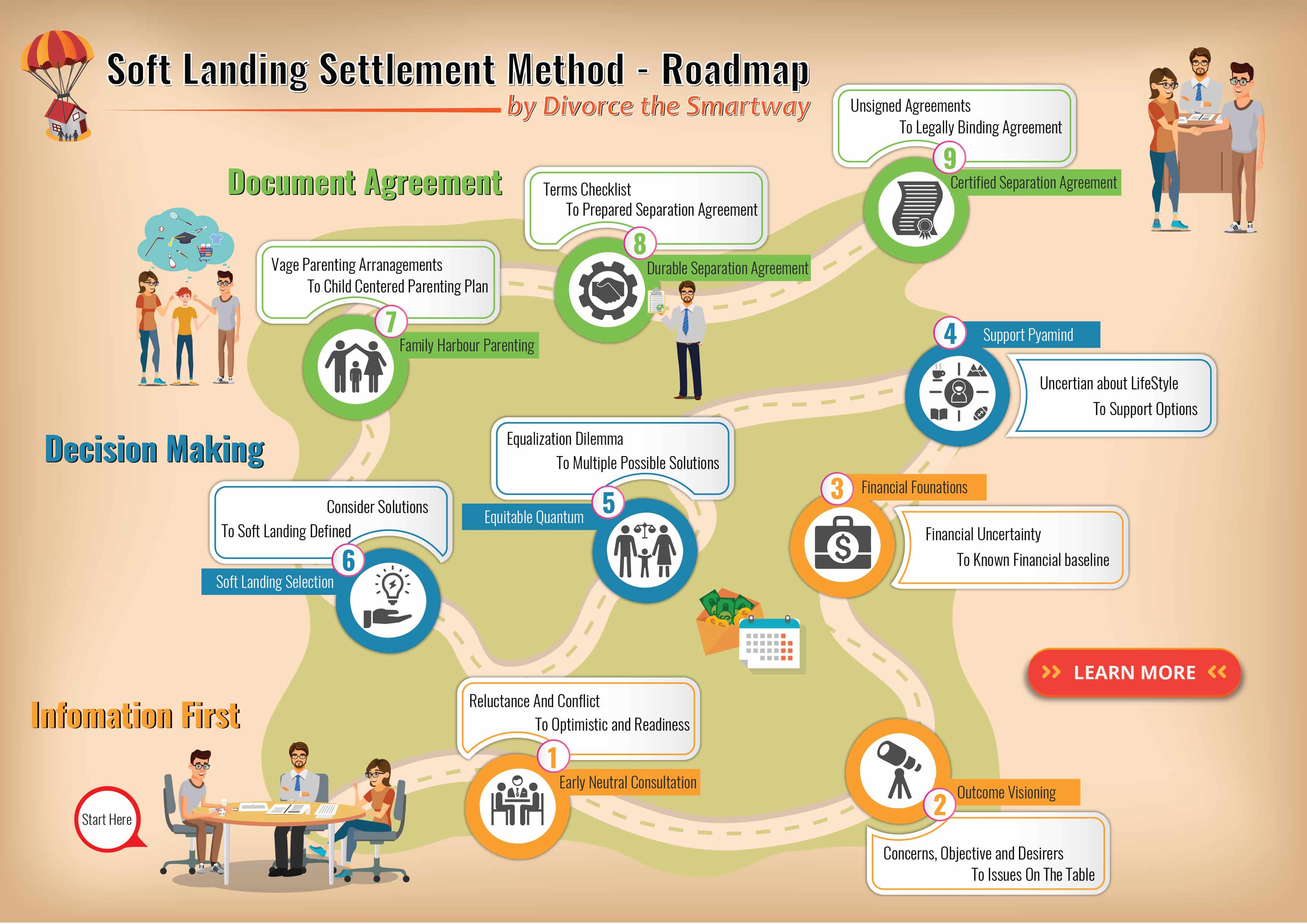
The Soft Landing Settlement Method
Most separating couples don’t need a battle — they need a plan. The Soft Landing Settlement Method is my structured approach to family mediation, built around a simple principle: information first, negotiation second. Before you and your spouse decide anything, you’ll both understand the complete financial picture and what each option actually means for your family — whether you’re building a parenting plan, working out support, or dividing property.
From there, I guide you through interest-based negotiation, step by step, toward a fair and amicable resolution — one that lands as a comprehensive divorce settlement or separation agreement your own lawyers can confirm before you sign. For Cobourg families, where the stakes on the home and the numbers on support are rarely simple, a soft landing isn’t about avoiding hard conversations. It’s about having them once, in the right order, with the right information on the table.
Click Image to enlarge Infographic
Fees: We use a hybrid fee structure: flat fees for defined deliverables — preparing your financial statements, drafting the parenting plan, drafting the separation agreement — and an hourly rate of $160 to $250 for mediation sessions, typically shared between spouses. A complete mediation runs about $6,000 for most working families, up to around $12,000 for more complex or higher-net-worth situations — total, for both of you, from first meeting to draft agreement.
Compare that with the retainer many family lawyers require from each spouse just to open a file, before a single issue is resolved. You’ll get exact numbers, in writing, on the Get Acquainted Call — before you commit to anything.
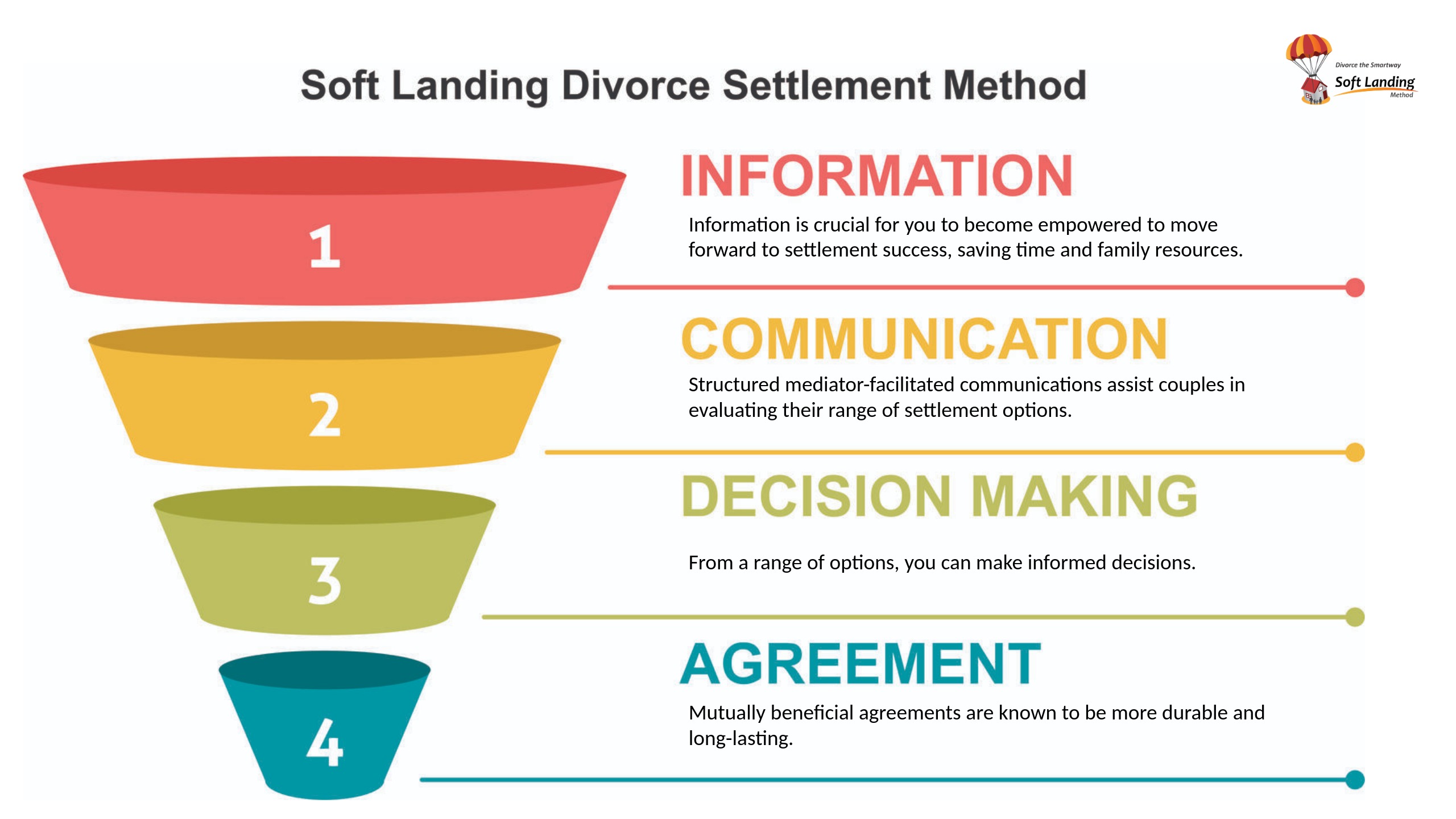
The Information First Model
The Information First Model from DTSW Mediation Services ensures a smooth and efficient separation process for couples. By starting with comprehensive client discussions, we understand your goals and concerns, acting as your intermediary.
Our method includes clear financial disclosures using our online tools, followed by a thorough financial walkthrough to ensure fair asset and liability division. This structured approach fosters effective communication and informed decision-making, helping couples achieve equitable settlements and secure futures.
Click Image to enlarge Infographic
11 Key Takeaways about Cobourg Mediation
- Soft Landing Method: A unique approach designed to minimize conflict and ensure a smooth transition for families.
- Mediation Services: Facilitates open communication to reach mutually beneficial agreements without court battles.
- Property Division: Simplifies the process of dividing assets fairly and equitably.
- Family Mediation: Reduces stress and conflict through efficient, amicable solutions.
- Legal Separation: Helps couples reach fair and amicable agreements, ensuring legal requirements are met.
- Separation Agreements: Formalizes terms of separation, covering key issues like asset division and child custody.
- Child Support: Ensures fair and appropriate support amounts based on income and needs.
- Parenting Plans: Develops comprehensive plans for shared responsibilities and decision-making.
- Zoom Mediations: Offers convenient online mediation sessions.
- Spousal Support: Determines fair support arrangements based on various factors.
- Financial Settlements: Helps couples reach fair financial agreements for clarity and security.
For more information or to schedule a Get Acquainted Call,
Discover how our Soft Landing Method can save you money and secure a brighter future with Divorce the Smartway.
For more information call: (705) 957-8016 · Toll Free 1.888.752.5819
Get Acquainted Call
Do you want a Soft Landing?
Have a few questions?
Learn More:
Schedule a 15-Minute Complimentary Call
No — and avoiding court is rather the point. A separation agreement reached in mediation and signed with independent legal advice is a binding domestic contract without a judge ever seeing your names. Court remains available if mediation genuinely fails, but the large majority of couples who complete the process reach full agreement — married and common-law alike.
Often, genuinely, yes. Two grid incomes mean disclosure is clean and support math is stable; two pension entitlements frequently offset rather than fight; mirrored benefits simplify the details. The file’s real work concentrates on the parenting plan and the home — which is exactly what mediation is best at. Symmetrical public-service files are routinely among the fastest and least expensive I complete, and they rarely have any business being in a courtroom.
First, the house gets valued twice — as-is and as-completed — because the gap between those numbers, minus the real cost to finish, is what you’re actually deciding about. Then the paths get priced: sell mid-project and split (someone buys your unfinished vision at a discount), one spouse takes the house and the completion risk in a buyout, or finish together under a written agreement covering who funds what, how contributions are repaid, and the sale timeline. Renovation debts and genuine sweat equity go into the math openly. There’s no universally right answer — but there’s always an honestly priced one.
Mostly the history — and it matters everywhere. Assets each of you brought into the marriage affect the equalization math through date-of-marriage deductions, so documenting what existed on the wedding day is step one. Support you already pay to a prior family shapes what’s affordable in this one. And where stepchildren are involved, support questions can extend to a spouse who stood in a parental role — a fact-specific issue worth targeted legal advice. None of it is unusual; all of it rewards doing the financial homework before negotiating, which is exactly how my process is built.
For modest-asset files, mediation isn’t just worth it — it’s the only economically sane option. Two litigation retainers can exceed the assets being divided; that’s not a settlement, it’s liquidation. My hybrid structure keeps costs proportional: flat fees for the defined pieces, hourly only for the sessions you actually need, shared between you — and a focused file with straightforward finances lands at the low end of the range. The Get Acquainted Call is free, and pricing comes in writing before you commit a dollar.
The process is the same; the questions are different — and they’re mostly financial. Later-life separation turns on retirement income: pensions already in pay and whether they’re shared, CPP credit splitting, whether the house sale funds two retirements, what support means when both incomes are fixed, and updating the beneficiary and estate arrangements a long marriage leaves behind. There’s less time to recover from a bad settlement at 62 than at 38, which is why the financial-analysis side of my practice matters most in exactly these files. Adult children may not need a parenting plan, but they notice how their parents part — mediation tends to leave that relationship intact too.
Nothing you’ve lost. Mediation in my practice is a closed (confidential, without-prejudice) process: offers and discussions can’t be used against you in court later. If you resolve eight issues out of ten, your lawyers argue about two issues instead of ten — the process narrows conflict even when it doesn’t end it. In practice, the large majority of couples who complete the process reach full agreement.
I’m a neutral — I work for both of you and the quality of the agreement, not for one side. A lawyer advocates for one spouse only. The two roles are complementary, not competing: I help you build the agreement; your own lawyers each confirm, through independent legal advice, that it protects you before you sign.
Yes. Plenty of couples come to me for parenting-only mediation, a support recalculation after a job change, or to resolve a single sticking point their lawyers couldn’t move. You don’t have to sign up for a full-scope process to get value from mediation.
You don’t need to be friendly — you need to be willing. Mediation is built for people in conflict; that’s why it exists. Screening, individual intake, structured agendas, and caucusing (meeting separately) let me mediate effectively even when direct conversation between you has broken down. What mediation can’t overcome is bad faith — hidden assets or refusal to participate.
No. Family mediation serves married and common-law couples alike. The parenting and support frameworks are essentially the same for both; property rules differ significantly (equalization applies to married spouses, while common-law property claims work differently), and I’ll make sure both of you understand which regime applies to you.
The mediation process itself isn’t binding — no one can impose an outcome on you. But the separation agreement that comes out of mediation is a legally binding domestic contract once it’s signed with independent legal advice and proper financial disclosure. That’s the whole point: you reach the decisions voluntarily, then formalize them enforceably.
Virtual Family Mediation
Zoom Video Family Mediation stands out as a unique and effective method for facilitating divorce mediation, offering a host of features that set it apart from traditional in-person mediation:
Accessibility
- Convenience and Flexibility: With Zoom Video Family Mediation, couples can participate from the comfort of their homes, eliminating the need for travel and allowing for more flexibility in scheduling, a significant advantage for those with busy schedules.
- Geographical Reach: It enables mediation for couples where both parties may not reside in Cobourg, or may live far apart in different locations, including cities or countries.
Efficiency
- Time-Saving: Virtual meetings can be scheduled more frequently, often leading to a faster resolution of issues.
- Cost-Effective: Zoom Video Divorce Mediation can be more affordable, as it eliminates the need for physical office space, travel expenses, and related costs, a significant benefit for those looking to manage their finances during the divorce process.
Comfort and Neutrality
- Neutral Environment: Both parties may feel more at ease in their own space, which can reduce stress and facilitate more productive discussions.
- Private and Secure: Zoom Video Family Mediation provides secure, private meeting rooms where discussions can occur without interruption. This ensures a safe and confidential environment, giving both parties the peace of mind they need during this sensitive process.
Enhanced Communication
- Technology Integration: The real-time sharing of screens, documents, and other resources enhances the mediation process.
- Recording Sessions: With both parties’ consent, sessions can be recorded for later review, ensuring clarity and transparency.
Flexibility and Adaptability
- Customizable Sessions: Mediators can tailor sessions to the specific needs of the couple, whether that involves shorter, more frequent meetings or longer, in-depth discussions.
- Use of Breakout Rooms: Zoom’s breakout room feature allows mediators to have private discussions with each party, similar to in-person caucusing.
Psychological Comfort
- Reduced Confrontation: Virtual mediation with Zoom can significantly lessen the confrontation in face-to-face meetings, helping to keep emotions in check and providing a sense of relief during this challenging time.
- Less Formal: The informal setting of a home environment can make the process feel less intimidating, promoting openness and cooperation.
Overall Effectiveness
- High Satisfaction Rates: Many couples report high levels of satisfaction with the process and outcomes of virtual mediation.
- Successful Outcomes: Zoom mediation is as effective as traditional in-person mediation in reaching agreements and resolving disputes.
In summary, Zoom Video Family Mediation offers a practical, efficient, and effective alternative to traditional in-person mediation. It provides numerous benefits that cater to the needs and circumstances of modern divorcing couples.