

Divorce Mediator vs Lawyer: Choose Wisely for a Better Future
Navigating the complexities of divorce can be overwhelming, especially when deciding on divorce mediation vs lawyer. In Ontario, understanding the distinct roles of family law mediators and divorce lawyers is crucial for making informed decisions that best suit your unique situation.
This blog post explores the benefits of choosing a lawyer or mediator for divorce, emphasizing how mediation offers cost-effectiveness, time efficiency, and emotional well-being. Learn how alternative dispute resolution methods can provide tailored solutions and maintain amicable relationships, ensuring a better future for all parties involved.
I found myself in your shoes back in 2007, a few years before I became a divorce mediator. Much like you, I was struggling to decide between going the divorce lawyer or divorce mediator route.
 I had three kids, aged between 5 and 12. We were living in a 4-bed home we’d bought two years earlier in a popular part of town, within earshot of the GO train. Between us, we had some modest investments but, like most families, we were struggling to balance the need to save money with the demands of supporting our young family.
We had a few financial problems. A recent rental property purchase was draining our cash flow, and the resulting stress was almost certainly a factor behind the break-up of our 15-year marriage. My wife moved out of the home at the end of the school end.
We needed external help to resolve our differences, so I researched our options. It was during this that I realized that the family law system in Canada was broken, leaving many individuals unaware of the choice between a family mediator vs attorney. Even the Chief Justice of Ontario Warren Winkler was troubled by the outcomes in his family courts.
Court proceedings with divorce lawyers were costly, complicated, even debilitating for some. Yet, for many, understanding the options between a mediator vs divorce lawyer could have offered a simpler solution.
 The cost of a litigated divorce through the court system in Canada was revealed in ‘Canadian Lawyer’ magazine . It was a staggering $12,000 per individual. And if that case went to trial, that cost would skyrocket to $45,000 per person.
Those kinds of sums isn’t an option for most people. They certainly weren’t for me back in 2007. I thought about going it alone, representing myself in court. A common approach people take according to a survey by the Toronto Lawyer’s Association. This revealed that 57% of family law litigants represent themselves in court, usually because they can’t afford a lawyer (National Post Report). The National Self-Represented Litigants Project (NSRLP) at the University of Windsor found that only 14% of those who defend themselves win their case.
I also discovered that the number of people self-litigating is constantly growing due to the expense of hiring lawyers. It means self-representation in divorce cases risks becoming as commonplace as a visit to the passport office. There’ll be less and less of the profound and venerable courtroom hearings you would expect from something as important as this.
Back then, taking the court route concerned me, because I was worried about the amount of time a judge – who faced their own budget pressures – would actually have to devote to our case.

Video: Winkler: No more studies needed!
And I was unsure whether an employee of the Crown was the best person to plan for my family’s future. Someone who’s never met me or my family. Who has no understanding of our specific needs nor any inkling of why I and my wife had ended up in court? There had to be another way.
 Ending your marriage by taking your spouse to court is something I’ve always found odd. Exploring the mediator vs divorce lawyer route might help simplify these complex processes for couples who were once happy together. Sure, things may have got edgier between us since those days, but it was still possible for us to have a civilized discussion and figure out between ourselves how to allocate our assets and support our children within the framework of the law.
It seemed to me that all the stress involved came from the litigation and the lawyers. Going to court was a process in which nobody won, but in which there were multiple ways of losing. That got me searching for a different option, a more sensible, practical alternative in which myself and my former partner could work things out between ourselves, meticulously shaping the future direction of our family while living apart.
 Together, we tried the self-drafted separation agreement route, but that seemed to be causing more conflict. We had issues to work out and, despite engaging in some email tennis, trying to solve them, we just couldn’t agree.
 All that emotion you’re storing up during your denial phase is going to have to come out sometime. And sure enough, it will. Anger soon rears its ugly head. I found the need to blame my spouse for what she was doing in my world, and our kids’ lives. And when other things in the world went wrong – job problems, car issues, lousy weather, that kind of thing, it was easy to blame my estranged wife for those too, even though they weren’t her fault. The anger also clouded my memories of my time with her, and when I looked back I saw nothing but negatives. Looking back, it was another essential emotional phase I had to go through. Although I made sure none of my kids heard anything I was venting about their mother.
There’s only so much anger you can vent against another person before you grow weary of it. Then you start to get a little more reasonable. You realize this is having an emotional impact on you that’s hard to handle. You’re looking for a way out to relieve the stress, puncture that anger-filled balloon. And that’s when  you’ll approach your spouse with the express intent of sorting things out so you can get your life back on track. During this phase, you’re often willing to accept that actually, yes, your spouse did have some good points and you did enjoy some great times. It’s almost the total opposite of what you were thinking during the Anger phase.
Sometimes, people who’ve been ditched take steps to get their spouse back no matter what, even at the expense of their sense of self-worth. Those who do the ditching? Well, they just have to wrestle with the doubt of whether or not the decision they’ve made is the right one.
After this, her demeanor changed. She became more empathetic and compassionate, and gently said, ‘I’m so sorry.’ Then she turned and left.
Handling A Divorce Application
Obviously, I knew what a Divorce Application was, but I didn’t really know what it meant. The documents certainly looked official, they had a lawyer’s name on them, but I needed to talk to someone, and that someone was Kevin, my hockey buddy and a much-respected family law lawyer in my area of town. He explained to me the purpose of the documents I’d been handed and what I needed to do.
 To summarize what he said, the divorce application I had been handed was a kind of shopping list of all the things my wife’s lawyer had filed with the court. Mine and her name, the names of our kids. What the judge needed to do. Kevin stated the cold hard reality of the situation – the self-written separation agreement my wife and I had produced wasn’t going to get it done. My spouse had upped the ante, taken the divorce process to a higher level. Our separation was now in the hands of the Family Law Courts.
What is the difference between a lawyer and a mediator?
When lawyers get involved in divorces, things get adversarial, particularly during litigation. If your separation has been fairly smooth up until now, expect to enter rough waters. After all, the lawyer is being paid for their services, and it’s up to them to extract the most fortuitous result for their client, no matter the cost or the damage caused. Kevin told me my wife already had a lawyer to represent her, now I needed one to represent me. How you hire a lawyer differs depending  on the province or county you’re in, and the type of lawyer you’re looking for and is the subject of another article.
Suffice it to say here that once you and your spouse have your separate divorce lawyers, you’ll be looking for them to establish, negotiate and resolve the issues resulting from the end of your marriage. If they can’t reach a conclusion between themselves, your divorce will move into the family court system and onto the dreaded litigation.
A date for the hearing of your case in court will be agreed upon. Your lawyers will begin preparing for it. Documents will be submitted to the court. Then, on the day, the arguments on both sides will be heard, experts and witnesses will testify, and your kids might even be involved. Presiding over all this, a family law judge who will ultimately decide the allocation of marital assets, the nature of parental responsibilities and child custody and other matters. It’s all out of your hands.
If you want a divorce, negotiating the terms of the separation is where you’re likely to be in dispute with your spouse and need a mediator. They will help you resolve any financial or custody issues so that your marriage can end without getting the courts involved.
 Even though the divorce mediator plays an active role during negotiations, the partners involved will enjoy full control over what’s discussed and the decisions that are made. Contrast that with arbitration and litigation, in which a judge takes control and makes all the decisions.
After Kevin had explained this to me, I still needed a little clarification. Couldn’t Kevin – who, remember, was a lawyer – mediate for me and my wife? After all, he was someone we both trusted and he knew our family.
But Kevin explained that most mediators aren’t lawyers, because being a mediator requires a unique skill set. He further clarified how the roles of mediator vs divorce lawyer vary in their approach to achieving fair outcomes. That’s not what mediation is all about. And anyway, Law Society rules would prevent him from representing both of us.
Kevin also addressed my worries about my divorce ending up in court, quoting a statistic that revealed that family cases in Ontario ended with out-of-court settlements in a massive 96% of cases. So very few actually went to trial. That begged the question why did so many people endure the headache and cost of hiring litigation lawyers if it was odds-on there’d be an out-of-court settlement? Surely it made more sense to proceed through separation with a spirit of compromise front of mind, rather than enter into an adversarial process?
Kevin knew where I was coming from and advised me to find a quality, impartial mediator who understood my concerns and was focused on finding a resolution to complicated financial issues associated with my divorce. Kevin also said there was no need to get a lawyer involved during mediation unless myself or my partner opted for one or needed legal advice as mediators do not provided legal advice.
It sounded like a great option – no litigation, no courts, no expensive lawyers. And it was a way forward that had been recommended to me by, of all people, a lawyer.
 After having been served with a Divorce Application by my spouse and talking to Kevin, I responded with an email that outlined a way we could move forward, with mediation at its heart. In the message, I outlined my reasons for wanting to take this approach
A divorce moderator is a neutral third party who helps couples negotiate their divorce settlement amicably
A divorce moderator, also known as a divorce mediator, is a trained professional who facilitates productive communication between separating couples. Their primary role is to help both parties reach mutually beneficial agreements on various aspects of their divorce.
These professionals assist with:
- Facilitating respectful discussions between spouses
- Helping identify common ground and potential solutions
- Guiding negotiations on property division, child custody, and financial arrangements
- Maintaining neutrality while ensuring both parties’ voices are heard
- Documenting agreements reached during mediation sessions
A divorce mediator facilitates negotiations while a lawyer advocates for one party’s legal interests
The key difference lies in their fundamental roles and objectives. A divorce mediator acts as a neutral third party who helps both spouses communicate effectively and reach mutually beneficial agreements. They don’t take sides or provide legal advice. A divorce lawyer specifically represents one spouse’s interests and provides legal counsel throughout the divorce process.
- Mediators focus on:
- Facilitating productive discussions
- Helping identify common ground
- Creating balanced solutions
- Reducing conflict and costs
- Lawyers focus on:
- Protecting client’s legal rights
- Providing legal advice
- Handling court proceedings
- Negotiating settlements
Many couples choose to work with both professionals, using mediation to resolve disputes amicably while having lawyers review agreements and protect their legal interests.
Mediation offers a more collaborative, cost-effective, and less adversarial approach to divorce
Choosing a divorce mediator instead of traditional litigation provides several significant advantages for separating couples. A mediator facilitates open dialogue and helps both parties reach mutually beneficial agreements in a neutral setting.
- Cost savings: Mediation typically costs 40-60% less than going through lawyers and court proceedings
- Faster resolution: Most mediated divorces conclude within 3-6 months, compared to 1-2 years for litigated divorces
- Better communication: Mediators help couples develop effective communication strategies that can benefit future interactions
- Greater control: Couples maintain decision-making power over their settlement terms rather than leaving decisions to the courts
- Reduced stress: The collaborative nature of mediation creates a less hostile environment, especially beneficial when children are involved
- Privacy protection: Unlike court proceedings, mediation sessions remain confidential and out of public record
Yes, divorce mediation is a cost-effective and collaborative way to navigate separation proceedings
A divorce mediator serves as a neutral third party who helps couples work through their separation agreement in a cooperative manner. This professional facilitates productive discussions about important matters while keeping emotions in check.
The mediation process typically addresses:
- Property division and asset distribution
- Child custody and parenting arrangements
- Support payments for children and/or spouse
- Pension and retirement account division
Choosing mediation over traditional litigation often results in reduced legal costs, faster resolution times, and better long-term relationships between former spouses. This approach is particularly beneficial when children are involved, as it sets a foundation for positive co-parenting.
Mediation is a collaborative settlement process, while court litigation puts decisions in a judge’s hands
Divorce mediation and court litigation represent two distinctly different approaches to ending a marriage. Mediation offers a cooperative, less adversarial process where couples work with a neutral mediator to reach mutually beneficial solutions. Going to court involves formal legal proceedings where a judge makes binding decisions about your divorce settlement.
Key differences include:
- Cost and time: Mediation typically costs less and moves faster than court proceedings
- Control over outcomes: Mediation allows couples to maintain decision-making power, while court puts control in the judge’s hands
- Atmosphere: Mediation provides a collaborative environment, whereas court tends to be more confrontational
- Privacy: Mediation sessions remain confidential, but court proceedings become public record
- Flexibility: Mediation allows for creative solutions, while court follows strict legal guidelines
A lawyer can serve as a mediator but cannot legally represent either spouse during divorce mediation
While lawyers can act as divorce mediators, they must maintain strict neutrality throughout the mediation process. As a mediator, their role shifts from legal advocate to impartial facilitator. The mediating lawyer helps both parties:
- Communicate effectively with each other
- Understand their legal rights and obligations
- Explore potential settlement options
- Reach mutually acceptable agreements
For ethical and legal reasons, a lawyer serving as mediator cannot provide individual legal advice or represent either spouse in the divorce proceedings. Each party should retain their own independent legal counsel to review any agreements reached during mediation.
Mediation typically costs 40-60% less than traditional divorce litigation
Divorce mediation is usually more cost-effective than going through lawyers and courts. While a traditional litigated divorce can cost $15,000-50,000+ per person, mediation often ranges from $3,000-8,000 total for both parties.
Cost savings come from several factors:
- Fewer billable hours since couples work together in joint sessions
- No court filing fees or litigation expenses
- Shared mediator costs between both parties
- Faster resolution timeline compared to court proceedings
- Option to consult lawyers only as needed for legal review
However, costs can vary based on your situation’s complexity and the number of mediation sessions required. Some couples resolve everything in 3-4 sessions, while others may need 8-10 meetings for more complicated divorces.
Choose a mediator for amicable divorces, or a lawyer for complex or contentious situations
The choice between a mediator and lawyer depends on your specific divorce circumstances. Mediation typically works best for couples who can communicate respectfully and are willing to negotiate fairly. It’s often more cost-effective and less adversarial than traditional legal proceedings.
Consider a lawyer if your situation involves:
- Significant assets or complex property division
- Child custody disputes
- Power imbalances between spouses
- History of domestic violence or abuse
- Communication breakdown between parties
Many couples benefit from using both services – working with a mediator to resolve straightforward issues while consulting individual lawyers to review agreements and protect their legal interests.
Mediators facilitate agreements between both parties, while lawyers advocate for one client’s interests in a divorce.
A divorce mediator serves as a neutral third party who helps couples work together to reach mutually beneficial solutions. They do not provide legal advice but rather guide the conversation and negotiation process. A divorce lawyer, however, represents only one spouse and provides legal counsel while protecting their client’s rights and interests.
- Mediators:
- Work with both spouses simultaneously
- Remain neutral and unbiased
- Help facilitate communication
- Guide couples toward mutual agreements
- Lawyers:
- Represent one spouse exclusively
- Provide legal advice and counsel
- Advocate for their client’s interests
- Navigate legal procedures and documentation
Conclusion to my journey
My divorce had been stuck in the court system for 20 months before we entered a mediation agreement for family mediation. And pretty much immediately, it gave us a sense of control at a time we were experiencing anxiety and disorientation. The process diffused our fears by creating a non-threatening structure in which we could make important decisions about our future separate lives.
During our early mediation sessions, we addressed short-term issues that remained unresolved and were adding to our stress levels. In later meetings, we tackled the bigger questions such as parenting schedules, managing finances, selling the family home and establishing separate households. The sessions gave us a deeper sense of security which allowed us to focus, with less anxiety, on the major tasks relating to our separation.
 How long does mediation take? In all, mediation took us about two months, which was about five sessions. The length of the process varies from couple-to-couple, depending on the decisions you make during the sessions. Our mediator played their role to perfection, assisting us to reach an agreement that suited us both, without taking sides. We both had a voice during the meetings, a major contributory factor to us reaching equitable outcomes around property division, spousal support, child support, custody, parenting plan arrangements and some minor concerns that needed resolving. We also learned new cooperation skills during mediation, and the whole process was way more amiable than our previous experiences with a lawyer, during which there was hostility, confrontation, and arguments.
What’s more, all our mediation services was carried out confidentially and in private, unlike divorce litigation which has to be a matter of public record.
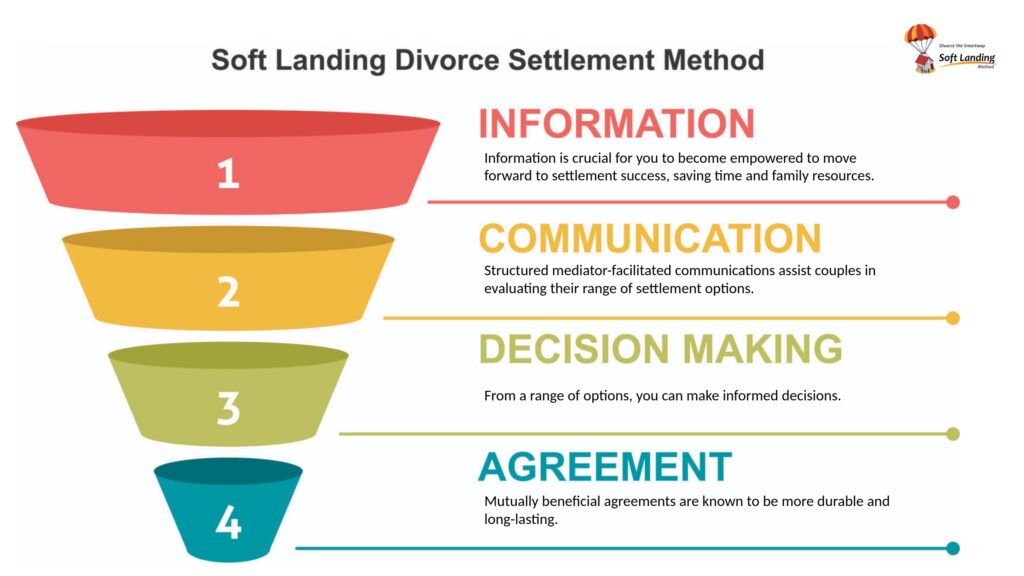
External links that may interest you:
- Mediator vs. Attorney: What’s the Difference? – Learn the roles of mediators and attorneys in disputes.
- Divorce Mediation vs Lawyer: Which is Right for You? – Compare mediation and legal representation in divorce.
- What is the Difference between Mediators and Lawyers – Understand the distinct professions of mediation and law.
- Mediation vs having lawyers? : r/DivorcedDads – Insights from divorced dads on mediation versus lawyers.
- Should I Hire a Lawyer or Use a Mediator for My Divorce? – Explore cost-effective and less combative options for divorce.
- Family Law Mediation vs. Litigation | Vancouver Divorce – Differences between family law mediation and litigation.
- The difference between mediation and a lawsuit – Compare the roles of mediators and lawyers in litigation.
- Breaking Down the Differences: Divorce Mediator vs. Lawyer – Mediators help reach agreements without judicial decisions.
- Mediation Vs Litigation: When Should You… – Find out when to mediate vs. litigate in divorce.
- Divorce Lawyer vs. Divorce Mediator – Family Mediation Center – Benefits of mediation services over litigation.
- Mediation for divorce: The benefits and pitfalls – Understand the advantages and disadvantages of mediation.
- Mediator vs Lawyer in Divorce: What’s Best for You? – Mediation offers a less formal, faster, and cost-effective path.
- Understanding Divorce Mediators vs. Lawyers – How mediators foster open communication for mutual agreements.
- What is a mediator? An easy guide to mediators vs divorce… – Mediators facilitate negotiations between disputing parties.
- Mediation – Information on mediation vs. family court and legal aid options.

Ken Maynard CDFA, Acc.FM
I assist intelligent and successful couples in navigating the Divorce Industrial Complex by crafting rapid, custom separation agreements that pave the way for a smooth transition towards a secure future. This efficient process is achieved in about four meetings, effectively sidestepping the excessive conflicts, confusion, and costs commonly linked to legal proceedings. Clients have the flexibility to collaborate with me either via video conference or in-person through a DTSW associate at any of our six Greater Toronto mediation centers, located in Aurora, Barrie, North York, Vaughan, Mississauga, and Scarborough.