
What Happens to Your TFSA in a Divorce or Separation in Ontario
A TFSA stays in one name, but its value on the day you separated goes into the equalization math. Here’s how it’s counted, how it can be transferred without tax, and which statements you’ll need.
A Tax-Free Savings Account (TFSA) belongs to the person whose name is on it, and the end of a marriage or common-law relationship doesn’t change that. What separation does change is the arithmetic. In Ontario, the value of your TFSA on the date you separated is counted in your net family property, and the growth in each spouse’s property over the marriage is equalized. So the account isn’t “split”, but its value is very much on the table.
This page covers the three things people actually ask: how a TFSA is counted when married spouses separate, how funds can move from one spouse’s TFSA to the other’s without tax consequences, and which statements you need for financial disclosure. The Canada Revenue Agency (CRA) transfer rule and the 2026 TFSA contribution room figures were checked against canada.ca on October 21, 2026.
Who owns it
The account holder, before and after separation
What’s counted
Its value on the separation date, at full face value
Tax on transfer
None, if moved TFSA to TFSA under a written agreement or order
2026 room
$7,000 for the year; $109,000 total since 2009
What happens to TFSA in divorce: the short version
For married couples in Ontario, the Family Law Act doesn’t divide individual assets. It calculates each spouse’s net family property (what you own minus what you owe on the separation date, less what you brought into the marriage), and the spouse with the larger number pays the other half the difference. That payment is the equalization payment. Your TFSA is one line in that calculation, the same as a chequing account, a car or non-registered investments.
Three consequences follow. First, nobody has a claim on your TFSA itself; they have a claim on a number. Second, a TFSA opened before the wedding is partly sheltered by the date-of-marriage deduction. Third, because TFSA money comes out tax-free, it’s counted at its full balance, with no discount for tax, which is the one way it differs from an RRSP in divorce.
If you weren’t married, none of that applies. Common-law partners don’t equalize property in Ontario; see the section below. The tax rules, on the other hand, treat a spouse or common-law partner the same way.
How a TFSA is counted in Ontario’s equalization
The valuation date balance
Everything turns on one date: the valuation date, which for most couples is the date of separation. Your TFSA’s market value on that day, investments and cash together, is the figure that goes into the calculation. Not today’s balance, not the balance when you file for divorce. If the account has gone up since you separated, the growth is yours; if it has gone down, the loss is yours too.
Because withdrawals from a tax-free savings account are not taxed, and growth inside it never attracts capital gains tax, the account goes in at its full value. An RRSP of the same size is usually discounted for the tax that will be paid when the money comes out. That means $50,000 in a TFSA is worth more in the equalization than $50,000 in an RRSP, and a fair settlement accounts for the difference. This is the kind of detail a Certified Divorce Financial Analyst checks before anyone signs.
A TFSA you had before the marriage
TFSAs started in 2009, so anyone married after that may have had one on the wedding day. Its value on the date of marriage is a deduction from your net family property under section 4(1) of the Family Law Act. Only the growth during the marriage is shared. You’ll need a statement from around the marriage date to prove the figure; if you can’t find one, your institution can usually produce historical statements, and CRA My Account shows your TFSA contribution room history year by year, which helps rebuild the number.
An inheritance or gift sitting in a TFSA
Money you inherited or were given by someone other than your spouse during the marriage is excluded property under section 4(2), as long as you can trace it. If you put an inheritance into your TFSA, the amount you contributed can be excluded. The investment growth on it inside the TFSA is excluded only if the will or the gift said the income was to be excluded as well; otherwise the growth is shared. Keep the paper trail: the estate cheque, the deposit, the contribution confirmation.
Contributions your spouse made to your TFSA
A TFSA can’t be joint, but one spouse or common-law partner can give the other funds to contribute, and the Income Tax Act’s attribution rules don’t apply to income earned in a TFSA. For family law purposes the account still belongs to the holder and is counted on the holder’s side of the ledger. Who funded it doesn’t move the asset from one column to the other.
After the separation date
Contributions you make after you separate, and growth after that date, are outside the equalization. So is anything the other person adds to theirs. The number is frozen on the valuation date; what you do with the account afterwards is your business, with one exception covered below under emptying the account.
Does the TFSA itself get split? Options and tax implications
No. The equalization payment is a sum of money owed by one spouse to the other, and the two of you decide how it gets paid. A TFSA can be part of that, but it doesn’t have to be. The usual choices:
| How the payment is made | What happens to the TFSAs | Tax and room effect |
|---|---|---|
| Cash from a non-registered account or savings | Both TFSAs stay intact | No tax; both spouses keep their contribution room |
| Direct transfer from one TFSA to the other | Payer’s TFSA shrinks, recipient’s grows | No tax; recipient’s room is untouched; payer’s room is not restored |
| Offset against another asset (home equity, RRSP, pension) | Both TFSAs stay intact | Depends on the other asset; an RRSP offset carries a tax discount |
| Payer withdraws, recipient deposits | Same dollars move, the wrong way | Counts as a new contribution for the recipient; can create an over-contribution taxed at 1% a month |
The last row is the mistake to avoid, and it’s common. The equalization payment page walks through the calculation itself; the division of assets guide covers how each kind of asset is treated.
The Canada Revenue Agency rule for TFSA transfers on marriage breakdown
The Income Tax Act allows a qualifying transfer from your TFSA straight into your spouse’s or former spouse’s TFSA with no tax and no effect on either person’s TFSA contribution room. In the CRA’s words, the transferred amount must relate to payments “under a decree, order, or judgment of a competent tribunal, or under a written agreement relating to a division of property in settlement of rights arising from the breakdown of their relationship”. In plain terms, both conditions in the CRA’s rule must be met:
- You and your spouse or common-law partner are living separate and apart at the time of the transfer, and
- The amount is payable under a written separation agreement, or under a court order or judgment, settling your rights on the breakdown of the marriage or common-law partnership.
The amount must be transferred directly by the financial institutions, from one individual’s TFSA to the other’s. Ask the receiving financial institution to initiate it; most have their own TFSA transfer form and will want a copy of the agreement or order. Investments can usually move in kind (the holdings themselves) or in cash (sold first, then moved). Expect a transfer fee at some institutions.
Two things the rule does not do. It doesn’t restore the transferor’s contribution room: a qualifying transfer isn’t a withdrawal, so nothing is added back the following January. And it doesn’t remove an excess TFSA amount, if the payer already has one, so any 1% monthly tax on the excess keeps running. The same structure exists for the newer First Home Savings Account.
Who gives up the tax shelter
This is the part worth negotiating. Say the equalization payment is $30,000 and the payer has $30,000 in a TFSA and $30,000 in a savings account. If the payment comes from the TFSA by direct transfer, the payer permanently loses $30,000 of tax-free room and the recipient gains $30,000 of tax-free savings on top of their own room. If it comes from the savings account, the payer keeps the shelter and the recipient can contribute the cash to their own TFSA only if they have room. Same dollars, different long-term value. In mediation we put both versions on the table so the choice is deliberate, not accidental.
Can I empty my TFSA before we separate?
You can withdraw your own funds at any time; nothing stops you. But it rarely helps. If the money is withdrawn before the separation date, the cash (or whatever you bought with it) is still your property on the valuation date and still goes into your net family property. If it’s spent, you’ll be asked where it went. Ontario’s Family Law Rules require full financial disclosure on Form 13.1, including property you disposed of in the two years before the statement (or during the marriage, if that’s shorter), and section 5(6) of the Family Law Act lets a court order an unequal split where one spouse has intentionally or recklessly depleted their assets. Withdrawals also give up contribution room until the following year.
You’ll read elsewhere that emptying a TFSA brings “court-ordered penalties”. The accurate version is less dramatic and more useful: it doesn’t reduce what you owe, it damages your credibility, and it can cost you an unequal division. The better move is to document the balance on the separation date and leave the account alone until the agreement is signed.
Common-law couples and TFSAs
If you lived together but never married, Ontario’s equalization regime doesn’t apply when the relationship ends. Each partner keeps the assets in their own name, TFSAs included, unless one of you can show an unjust enrichment claim, which is rare for a savings account and usually about homes and businesses. What you can still do is agree to a payment in a written separation agreement, and if you do, the CRA’s qualifying-transfer rule works for a common-law partner’s TFSA exactly as it does for a married spouse’s, with the same “living separate and apart” condition. The common-law separation guide covers the rest.
Update your successor holder and beneficiary after the marital breakdown
Most TFSA holders name their spouse or common-law partner as successor holder, which lets the spouse take over the account tax-free on death, or as beneficiary. Separation and divorce do not automatically cancel that designation in Ontario; the rule that revokes gifts to a former spouse in a will doesn’t reach beneficiary designations on registered plans. If you don’t change it, a former spouse can inherit the account years after the divorce. Changing it is a one-page form at your institution. Do it when the separation agreement is signed, and check your RRSP, pension and life insurance at the same time.
The TFSA statements you need for financial disclosure
Every spouse completing a financial statement for a separation has to disclose each tax-free savings account with its balance on the relevant dates, the same as any other registered account. Here is what to gather.
| TFSA disclosure | |
|---|---|
| Dates you need | Date of marriage (if the account existed), date of separation, and the most recent statement |
| Where to find it | Online banking or investing portal under statements or documents; your advisor; the institution by phone. CRA My Account shows contribution room and history, not balances |
| Who the document belongs to | The account holder. There are no joint TFSAs, so each spouse produces their own |
| How often statements come | Monthly or quarterly depending on the institution; quarterly statements usually cover March, June, September and December |
| What to look for | Market value on the statement date, cash balance, contributions and withdrawals in the period, and the account type (savings, GIC or investment) |
| If the separation date falls mid-period | Ask the institution for a balance as of that exact date, or use the nearest statement and note the dates of any transactions in between |
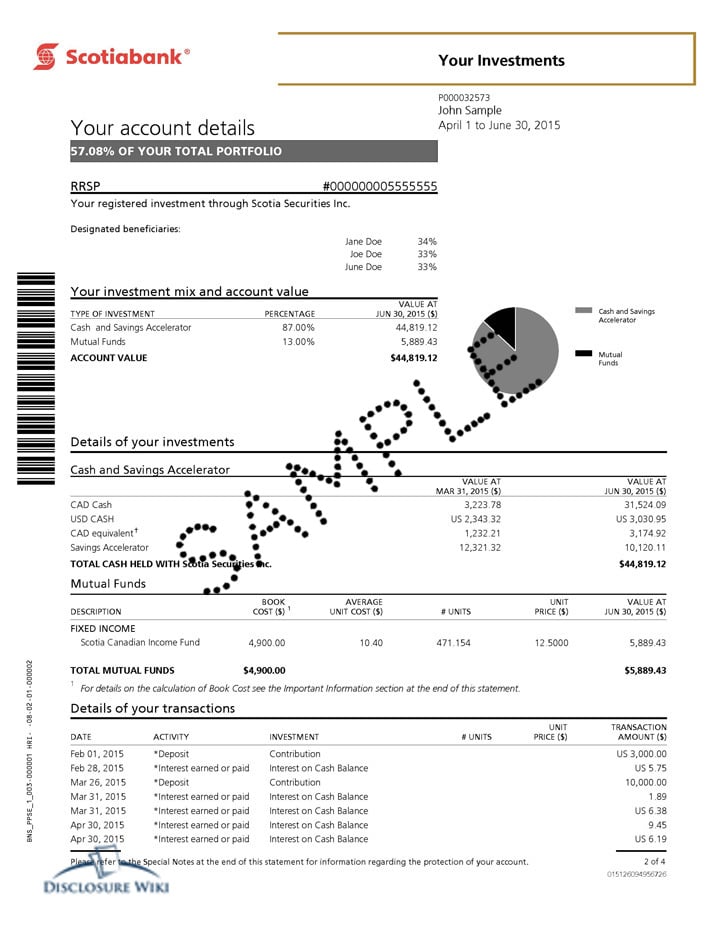
To get a digital copy, download the PDF from your institution’s portal, use your browser’s print-to-PDF on the statement page, or scan the paper copy. Our disclosure workshop does this assembly with you for every account, not just the TFSA.
TFSA vs RRSP (Registered Retirement Savings Plan) in a separation
| TFSA | RRSP | |
|---|---|---|
| Value in net family property | Full balance on the separation date | Balance less a discount for the tax payable on withdrawal |
| Tax when the money comes out | None | Taxed as income |
| Transfer to a spouse on separation | Direct TFSA-to-TFSA transfer under the CRA rule; the financial institution’s form | Direct RRSP-to-RRSP transfer under section 146(16); CRA Form T2220 |
| Effect on contribution room | Recipient’s room untouched; payer’s room not restored | No effect on either spouse’s RRSP room |
| Can it be joint? | No | No (a spousal RRSP is still owned by the annuitant) |
| Successor or beneficiary | Successor holder or beneficiary; update after separation | Beneficiary; update after separation |
The full treatment of the other account is on the RRSP in divorce page, and locked-in accounts have their own rules on the LIRA page.
Want the TFSA, RRSP and pension numbers done properly before you negotiate?
A settlement that treats a tax-free dollar and a taxable dollar as equal leaves one of you short. On a free Get Acquainted Call we’ll tell you what a Certified Divorce Financial Analyst would check in your file.

Reading keeps you informed. Talking helps you feel better.
If you’ve read everything and still don’t know your next step, let’s talk it through in a free, no-pressure call.
TFSA in divorce: FAQ
What happens to TFSA in divorce in Ontario?
It stays in the holder’s name, but its value on the separation date is counted in the equalization of net family property
Married spouses in Ontario don’t divide individual accounts. Each spouse’s net worth on the separation date, less what they brought into the marriage, is compared, and the spouse with more pays half the difference. Your TFSA balance is one figure in that calculation, at full value because withdrawals aren’t taxed.
Is a TFSA split 50/50 in a divorce?
Not the account itself; the growth in each spouse’s total property during the marriage is equalized
A TFSA can be used to pay the equalization payment, by direct transfer, but it doesn’t have to be. Cash, home equity or an RRSP offset are all options, and they have different tax and contribution-room effects.
Can a TFSA be transferred to my spouse tax-free on separation?
Yes, by a direct TFSA-to-TFSA transfer under a written separation agreement or court order while you’re living separate and apart
The Canada Revenue Agency calls this a qualifying transfer. It’s done by the financial institutions, not by withdrawing and re-depositing. The recipient’s TFSA contribution room is unaffected; the transferor’s contribution room is not restored.
Does a TFSA transfer on divorce use up contribution room?
A direct transfer doesn’t use the recipient’s room, but the payer doesn’t get their room back
Because the transfer isn’t a withdrawal, nothing is added to the payer’s room the next January. If the money is withdrawn and deposited instead, it counts as a new contribution for the recipient and can trigger the 1% monthly over-contribution tax.
Can I empty my TFSA before divorce?
You can, but the money is still counted and the withdrawal can cost you credibility and contribution room
Property you held on the separation date goes into your net family property whether it’s in the TFSA or in cash. Form 13.1 asks about property disposed of in the two years before the statement, and a court can order an unequal division where a spouse has recklessly depleted their property.
Does a TFSA I had before marriage count in the divorce?
Only the growth during the marriage counts; the date-of-marriage value is deducted
You’ll need a statement from around the wedding date to prove the figure. Your institution can usually produce historical statements, and CRA My Account shows your contributions by year.
Can a TFSA be a joint account?
No, a TFSA is always held by one person, though a spouse or common-law partner can give you funds to contribute
Who funded the account doesn’t change the ownership. For equalization, the TFSA is counted in the holder’s net family property.
What TFSA documents do I need for financial disclosure?
Statements showing the balance on the date of marriage (if it existed), the date of separation and today
Download them from your institution’s portal or ask for historical statements. CRA My Account shows contribution room and history but not account balances.

Ken S. Maynard
- APFM - Association of Private Family Mediators Canada
- CDFA - Certified Divorce Financial Analyst
- Member, Association of Family and Conciliation Courts (AFCC)
- Member, Family Dispute Resolution Institute of Ontario (FDRIO)
I help intelligent, successful couples move through separation without getting pulled into the adversarial legal system. Together we craft a custom separation agreement that sets you up for a secure future and a smooth transition to the next chapter.
Many couples reach a complete agreement in about four meetings. Others need more time, and that's fine. The pace is set by your situation, not by a formula. Either way, you sidestep most of the conflict, confusion, and cost that come with going through the courts.
You can work with me by video conference or meet in person with a DTSW associate at any of our six Greater Toronto mediation centres in Aurora, Barrie, North York, Vaughan, Mississauga, and Scarborough.