

Collaborative Divorce in Toronto, Ontario: Cost, Process and Alternative





Collaborative Divorce vs Mediation: What’s the Difference?
People searching for collaborative divorce in Toronto are almost always weighing it against mediation. They are not the same process.
| Label | Collaborative Divorce | Family Mediation |
|---|---|---|
| Who leads | Two collaborative lawyers advocate; specialists join as needed | One neutral mediator facilitates |
| Legal advice | Continuous — your lawyer is in every meeting | Independent legal advice on the finished agreement |
| Team size | 4+ professionals possible | 1 neutral (plus ILA lawyers at the end) |
| Cost structure | Two hourly lawyers from day one recognition | One professional; lawyers only for final review |
| Typical cost | ~$15,000+ per spouse in major centres | A fraction of collaborative — typically a few thousand per family |
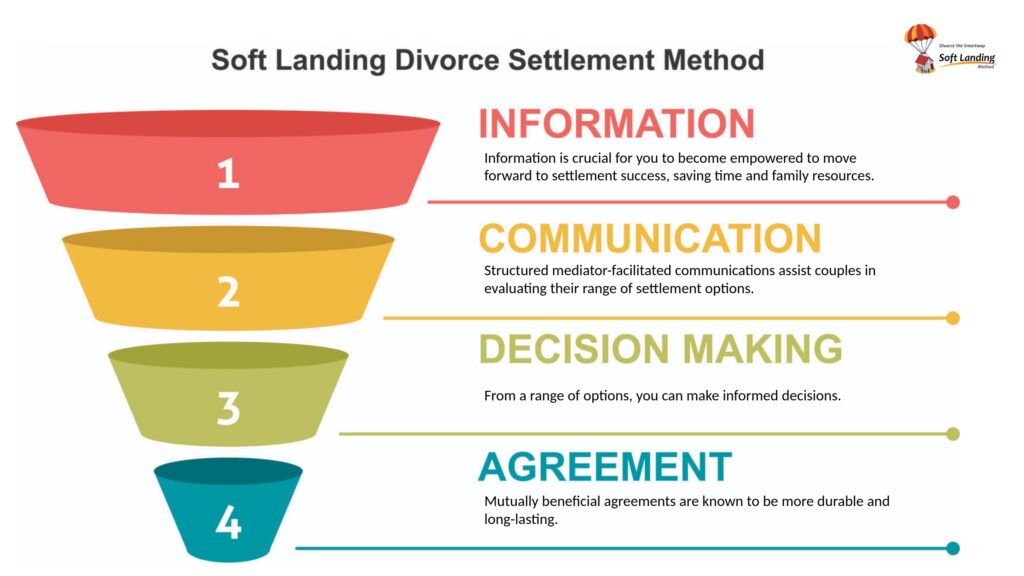
| Timeline | 4–6 months | Often faster — the Soft Landing Method targets 4 meetings or less |
| If it fails | Both lawyers must withdraw; restart with new counsel | Your ILA lawyers can continue acting for you |
| Best for | High conflict needing constant advocacy; complex files where each spouse wants counsel present | Couples who can sit at the same (or virtual) table and want a cost-efficient path to a binding agreement |

Frequently Asked Questions About Collaborative Divorce in Toronto
The main difference is who is in the room. In collaborative divorce, each spouse has their own lawyer present and advising them at every negotiation meeting. In mediation, a neutral mediator facilitates the negotiation, acts for neither spouse, and each person obtains independent legal advice separately before signing an agreement.
Both are voluntary, private, out-of-court processes that rely on full financial disclosure, and both can produce a binding separation agreement. Mediation is often the more cost-efficient structure where it is suitable; collaborative practice provides continuous legal advice and a coordinated team, which some families need.
It depends. There is no fixed timeline, because the duration reflects the number and complexity of issues, how quickly financial disclosure is completed, how many joint meetings are needed, and how readily both spouses can make decisions. Some families resolve matters in a few meetings; others need many months.
A realistic way to gauge timing is to ask prospective lawyers, at the first consultation, how many joint meetings files like yours have typically required and what tends to slow them down.
Often, the collaborative lawyers must withdraw, and each spouse retains new counsel if the matter proceeds to court. This flows from the participation agreement most collaborative professionals use, and it is intended to keep everyone committed to settlement rather than positioning for litigation.
The practical consequence is financial: fees already paid to the collaborative team do not transfer, and new litigation counsel must be retained and briefed. Understanding this provision — and asking your lawyer to explain it before you sign — is an essential part of informed consent to the process.
Yes. Collaborative divorce is built on each spouse having separate, collaboratively trained legal counsel who advises them throughout the negotiation. One lawyer cannot act for both spouses, and the process does not proceed unless both people are independently represented.
This is one of the defining differences from mediation, where a neutral mediator facilitates the negotiation and each person obtains independent legal advice separately, typically before signing the separation agreement.
It depends on your circumstances, and no fixed price can be quoted responsibly. Each spouse pays their own collaborative lawyer, and fees reflect the number of meetings, the complexity of the issues, the quality of financial disclosure, and whether specialists such as a neutral financial professional join the team. Ask prospective professionals for hourly rates, retainer requirements, and a written estimate.
Because two lawyers participate throughout, collaborative divorce can cost more than mediation for comparable issues — though a shared neutral financial professional can sometimes reduce duplication. The largest financial risk is the withdrawal provision: if the process ends without settlement, both spouses may need to retain new litigation counsel.

Ken Maynard
I assist intelligent and successful couples in navigating the Divorce Industrial Complex by crafting rapid, custom separation agreements that pave the way for a smooth transition towards a secure future.
This efficient process is achieved in about four meetings, effectively sidestepping the excessive conflicts, confusion, and costs commonly linked to legal proceedings.
Clients have the flexibility to collaborate with me either via video conference or in-person through a DTSW associate at any of our six Greater Toronto mediation centers, located in Aurora, Barrie, North York, Vaughan, Mississauga, and Scarborough.