

Insider Tips on Child Custody That Lawyers Won’t Share
It’s important to note that the court-mandated custody arrangement determines whether the children will primarily live with one parent or split their time between both parents. It’s also crucial to distinguish between custody and access arrangements. Access refers to the non-residential parent’s right to spend time with the children, and it can vary based on the parent’s ability to work together. In cases where one parent has a history of abuse or neglect, the court may restrict their access to the children.
Government of Canada. “Selected Statistics on Canadian Families and Family Law.” Department of Justice, 2000. Accessed on June 18 2023. Available at: Tap Here.
Prepare thoroughly for custody mediation by organizing documentation, setting clear goals, and maintaining a child-focused mindset.
Successful child custody mediation requires careful preparation and a commitment to constructive dialogue. The key is to focus on your child’s wellbeing while demonstrating your ability to co-parent effectively.
Essential preparation steps include:
- Gather important documentation including:
- School records and schedules
- Medical information
- Current parenting schedule
- Extracurricular activities calendar
- Create a detailed parenting plan proposal that addresses:
- Regular custody schedule
- Holiday arrangements
- Special occasions
- Transportation logistics
- Prepare a list of child-centred priorities and concerns
- Practice maintaining a calm, professional demeanour
- Consider flexible alternatives and compromise solutions
Remember to approach mediation with a collaborative mindset and focus on achieving outcomes that serve your child’s best interests.
Child custody lawyers have potential drawbacks despite their expertise, including higher costs and increased adversarial tension
While child custody lawyers provide essential legal guidance, there are several important considerations before engaging their services. A traditional legal approach can sometimes escalate tensions between parents and impact both financial and emotional well-being.
- Higher costs – Legal representation typically involves significant hourly rates, retainer fees, and court-related expenses
- Increased conflict – The adversarial nature of legal proceedings may damage co-parenting relationships
- Reduced control – Court decisions may not align with either parent’s preferred arrangements
- Extended timeline – Legal proceedings often take longer than collaborative approaches like mediation
Consider exploring alternative dispute resolution methods like mediation first, which often leads to more amicable, cost-effective, and mutually satisfactory outcomes while preserving parental relationships.
If mediation is unsuccessful, you can proceed with formal legal action through the courts
When mediation doesn’t result in an agreement, several alternative dispute resolution options remain available. While court litigation is the most common next step, it’s important to understand your choices:
- Pursue traditional court litigation with legal representation
- Try collaborative law with specially trained lawyers
- Attempt a second mediation with a different mediator
- Seek arbitration for a binding decision
Most family law professionals encourage continuing negotiations even after unsuccessful mediation, as court proceedings tend to be more costly, time-consuming, and emotionally challenging for all parties involved.
Mediation is a structured negotiation process guided by a neutral third party to create a child custody agreement
The child custody mediation process involves confidential meetings where both parents work with a qualified mediator to develop a mutually acceptable parenting arrangement. This collaborative approach focuses on the best interests of the child while helping parents communicate effectively.
- Initial consultation to explain the process and gather background information
- Joint sessions where both parents discuss their concerns and priorities
- Structured negotiations covering schedules, decision-making, and parenting responsibilities
- Development of a detailed parenting plan that addresses custody and access arrangements
- Review and refinement of the agreement before finalizing
The process remains non-binding until both parties sign the final agreement, allowing flexibility to make adjustments as needed. Most mediations conclude within 3-5 sessions, though complex cases may require additional time.
Mediation can be successful in high-conflict situations when managed by a qualified professional mediator
High-conflict separation or divorce doesn’t automatically rule out mediation as an effective solution. A professional mediator is specifically trained to handle challenging dynamics between ex-partners and can employ various techniques to keep discussions constructive.
- Mediators create a structured environment where both parties feel heard and respected
- Sessions can be conducted in separate rooms (shuttle mediation) if direct contact is too difficult
- Clear ground rules and communication protocols help manage emotional tensions
- The process focuses on future-oriented solutions rather than past conflicts
- Mediators remain neutral while ensuring both parties have equal opportunities to express their needs
With proper mediation techniques and willing participants, even highly conflicted couples can reach mutually beneficial agreements while saving time and money compared to litigation.
Mediation provides a collaborative, cost-effective way to resolve custody disputes while prioritizing children’s wellbeing
Choosing family mediation over litigation offers significant advantages for parents navigating child custody arrangements. This cooperative approach helps preserve relationships and creates lasting solutions that work for everyone involved.
- Reduces emotional stress on children and families compared to court proceedings
- Typically costs 60-70% less than traditional litigation
- Allows parents to maintain control over important decisions about their children
- Creates flexible arrangements that can adapt to changing family needs
- Promotes positive co-parenting relationships through improved communication
- Usually resolves disputes faster than court proceedings
Through professional mediation services, parents work together with a neutral third party to develop customized parenting plans that prioritize their children’s best interests while respecting both parents’ rights and responsibilities.
Child custody arrangements are best handled through collaborative mediation with both parents focused on the child’s wellbeing.
Working with a professional mediator helps parents develop a comprehensive parenting plan that prioritizes their children’s needs while maintaining positive family relationships. This approach is typically more cost-effective and less stressful than court litigation.
A successful custody arrangement should address:
- Residential schedule – including regular routines, holidays, and special occasions
- Decision-making responsibilities – regarding education, healthcare, and activities
- Communication protocols – between parents and with children
- Flexibility provisions – for handling schedule changes and emergencies
- Conflict resolution methods – for addressing future disagreements
Remember that custody arrangements can be modified as children grow and family circumstances change, making it essential to maintain open dialogue and cooperation between both parents.
Fathers can achieve 50/50 custody when they demonstrate active involvement and the ability to support their child’s best interests.
In Canadian family courts, the likelihood of obtaining shared custody has significantly improved for fathers in recent years. The courts prioritize the best interests of the child when determining custody arrangements. Several key factors influence the outcome:
- Parental involvement – Historical relationship and participation in the child’s daily activities
- Living arrangements – Suitable housing and proximity to the child’s school
- Co-parenting ability – Willingness to communicate and cooperate with the other parent
- Work schedule flexibility – Ability to accommodate the child’s routine and activities
- Child’s preferences – When age-appropriate, the child’s wishes may be considered
Modern Canadian courts recognize the importance of maintaining strong relationships with both parents, making shared custody arrangements increasingly common when both parties demonstrate their capability to provide stable, nurturing environments.
Getting 50/50 custody is achievable when both parents demonstrate their ability to provide quality care
Obtaining shared custody has become increasingly common in Canadian family courts, as judges recognize the benefits of children maintaining strong relationships with both parents. The success of achieving 50/50 custody arrangements typically depends on several key factors:
- Both parents’ demonstrated ability to cooperate and communicate effectively
- Geographical proximity between both homes to maintain school and activity schedules
- Each parent’s ability to provide a stable, nurturing environment
- The child’s existing routine and relationship with each parent
- Both parents’ willingness to put the child’s best interests first
Modern family courts generally favour shared custody when these conditions are met, as research shows children often benefit from maintaining meaningful relationships with both parents. The key is demonstrating that the arrangement serves the child’s emotional, physical, and social well-being.
50/50 custody across school districts requires careful planning and coordination between parents to maintain educational stability
Managing shared custody between different school districts demands thoughtful organization to ensure a child’s academic success and routine stability. Co-parents must establish clear arrangements that address both educational and practical considerations.
Key factors that parents need to coordinate include:
- Primary school registration and determining which district the child will attend
- Transportation logistics between homes and school
- Homework supervision and academic support responsibilities
- Access to extracurricular activities and school events
- Communication with teachers and school administration
- Emergency contact protocols and medical authorizations
Parents should document these arrangements in their custody agreement and maintain flexibility to adjust the schedule as needed to prioritize their child’s educational needs.
Winning sole custody requires proving it serves the child’s best interests through court evidence and documentation
In Ontario, obtaining sole custody requires demonstrating to the court that having one primary custodial parent is in the child’s best interests. The process involves building a compelling legal case with proper documentation and evidence.
To strengthen your case for sole custody, you’ll need to:
- Document your consistent involvement in the child’s daily life, education, and healthcare
- Provide evidence of your ability to maintain a stable, nurturing home environment
- Demonstrate willingness to facilitate the child’s relationship with the other parent
- Present proof of any concerns about the other parent’s ability to provide proper care
- Show documentation of your financial stability and ability to provide for the child
Working with a qualified family law lawyer is strongly recommended, as they can help navigate the complex legal requirements and present your case effectively to the Ontario courts.
Full custody grants one parent complete legal and physical rights over a child’s care and upbringing
Full custody (also called sole custody) means one parent has exclusive authority over both the daily care and major life decisions for their child. This comprehensive arrangement includes:
- Legal custody rights – authority over decisions about education, healthcare, religion, and other significant matters
- Physical custody rights – responsibility for the child’s day-to-day care, housing, and routine activities
- Primary residence – the child lives mainly or exclusively with the custodial parent
While the non-custodial parent may retain visitation rights (also called access or parenting time), they do not have legal authority to make important decisions about the child’s upbringing. Full custody arrangements are typically granted when courts determine this serves the child’s best interests.
A judge denies 50/50 custody when it does not serve the child’s best interests
Courts prioritize the child’s well-being above all else when determining custody arrangements. A judge may reject equal parenting time for several significant reasons:
- Parental stability concerns, including inconsistent housing, employment, or lifestyle issues
- Geographic distance between parents that would disrupt the child’s schooling or routine
- History of family violence or substance abuse that poses safety risks
- Demonstrated inability of parents to communicate or cooperate effectively
- Child’s established routine and emotional bonds with primary caregiver
- Special needs of the child that one parent is better equipped to handle
A custody dispute is a legal disagreement between parents over child care arrangements and decision-making rights.
A custody dispute arises when separated or divorced parents cannot reach an agreement about how to care for and make decisions regarding their children. These disputes typically involve negotiations or legal proceedings to determine:
- Physical custody – where the child will live and spend time
- Legal custody – who has the authority to make important decisions about education, healthcare, and religion
- Parenting time – the schedule for when each parent spends time with the child
- Decision-making responsibilities – how parents will collaborate on major choices affecting the child’s welfare
Joint custody arrangements now account for over 50% of Canadian custody cases, with a growing trend toward shared parenting.
Modern child custody arrangements in Canada increasingly favour shared parental responsibility, moving away from traditional sole custody models. Courts prioritize the best interests of the child while recognizing the importance of maintaining meaningful relationships with both parents.
- Physical custody arrangements typically see children spending significant time with each parent
- Joint legal custody remains the most common arrangement, allowing both parents to participate in major decisions
- Sole custody cases have declined significantly over the past decade
- Shared custody arrangements (40-60% time split) continue to rise annually
This shift reflects contemporary research showing children generally benefit from maintaining strong connections with both parents following separation or divorce.
Multiple factors including abuse, neglect, substance use, and instability can impact custody decisions
During custody proceedings, courts carefully evaluate various aspects of each parent’s life and behaviour to determine the best interests of the child. Several key factors can negatively influence a custody decision:
- History of abuse or neglect – Including physical, emotional, or verbal abuse towards children or family members
- Substance use issues – Current or past problems with alcohol, drugs, or prescription medication misuse
- Unstable living conditions – Frequent moves, unsafe housing, or inability to maintain consistent employment
- Poor parenting practices – Including alienating the child from the other parent or failing to support the child’s education
- Mental health concerns – Untreated conditions that could impact parenting ability
- Criminal history – Especially offences involving violence, drugs, or endangering minors
Courts prioritize creating a safe, nurturing environment that supports the child’s physical, emotional and social development. Any behaviour or circumstance that could compromise the child’s wellbeing may influence the final custody determination.
50/50 custody is achievable when both parents demonstrate capability and commitment to shared parenting
In Ontario, courts generally favour shared custody arrangements when they serve the best interests of the child. The likelihood of obtaining 50/50 custody increases significantly when certain key factors are present.
Your chances of securing shared custody improve when:
- Both parents demonstrate active involvement in the child’s daily life
- Parents show ability to communicate effectively and cooperate
- Both households are within reasonable proximity to the child’s school
- Parents can maintain consistent routines and schedules
- The arrangement supports the child’s emotional and social development
- Both parents have suitable living arrangements and resources
Courts assess each case individually, considering factors like the child’s age, existing relationships, and established care patterns when determining if shared custody is appropriate.
Fathers can successfully obtain 50/50 custody by demonstrating active parental involvement and co-parenting abilities
In modern Canadian family courts, the likelihood of fathers receiving equal shared custody has significantly improved. The courts prioritize the best interests of the child above all other considerations. Judges evaluate several key factors when determining custody arrangements:
- The father’s historical involvement in childcare and daily routines
- Demonstrated ability to provide a stable, nurturing environment
- Willingness to support the child’s relationship with the other parent
- Proximity of residences to minimize disruption to the child’s routine
- Work schedule flexibility and childcare arrangements
- The child’s existing relationship with both parents
Fathers who actively participate in their children’s lives, maintain positive co-parenting relationships, and can provide suitable living arrangements have a strong chance of achieving 50/50 custody. The courts generally recognize that children benefit from maintaining meaningful relationships with both parents when circumstances permit.
Supervised visitation in Ontario requires a qualified supervisor present during parent-child visits to ensure safety and compliance with court orders.
In Ontario, supervised access visits follow strict guidelines to protect children while maintaining important family relationships. These visits take place in designated supervision centres or approved locations with a qualified supervisor monitoring all interactions.
- Visits typically last 1-3 hours and must be scheduled in advance
- Supervisors maintain detailed records of all interactions and behaviours
- Both parents must follow specific arrival and departure protocols
- No unauthorized individuals may attend the visits
- Electronic devices and photography may be restricted
The supervision requirements can be modified based on court orders, risk assessments, and recommendations from family services professionals. Some cases may progress to supervised exchanges or unsupervised visits as circumstances improve.
In Ontario, both parents have equal custody rights when no court order exists
Under Ontario family law, both parents automatically share equal custodial rights and responsibilities for their children when there is no formal court order in place. However, this informal arrangement can lead to challenges and uncertainties. To protect everyone’s interests, parents should consider:
- Establishing a formal custody agreement through mediation or legal channels
- Creating a detailed parenting plan that outlines schedules, decision-making, and responsibilities
- Documenting important arrangements regarding education, healthcare, and living arrangements
- Working with a family mediator to develop mutually agreeable solutions
While equal rights exist by default, formalizing custody arrangements helps prevent future disputes and ensures the best interests of the child remain the primary focus.
Sole decision-making grants authority over major choices, while sole custody includes both decision rights and primary physical care
Sole decision-making authority specifically refers to one parent’s legal right to make important decisions about their child’s upbringing, including:
- Education and school choice
- Medical and healthcare decisions
- Religious upbringing
- Major extracurricular activities
Sole custody is a broader arrangement that combines two key elements: exclusive decision-making authority and primary physical custody. This means the custodial parent not only makes major decisions but also provides the main residence where the child lives and spends most of their time. The non-custodial parent may still have visitation rights or parenting time, but does not share in the primary caregiving or decision-making responsibilities.
Courts prioritize the child’s best interests rather than declaring a “winner” in custody cases
In Canadian family law, custody decisions focus on creating optimal arrangements for the child’s wellbeing and development. The court considers multiple factors when determining custody arrangements:
- Primary caregiver history – who has been responsible for daily care and routines
- Parental capability – each parent’s ability to provide care, support, and stability
- Living arrangements – suitable housing and proximity to school/activities
- Child’s relationships – connections with siblings, extended family, and community
- Child’s preferences – when age-appropriate and maturity permits
The goal is typically to establish shared parenting arrangements that allow children to maintain meaningful relationships with both parents, unless circumstances indicate this would not serve the child’s best interests.
Getting child custody requires filing a court application and proving you can provide the best environment for your child’s wellbeing.
Securing child custody in Canada involves a structured legal process focused on demonstrating your ability to support your child’s best interests. The court carefully evaluates several key factors before making their decision.
- Gather detailed records of your parental involvement, including school participation, medical appointments, and daily care routines
- Document your ability to provide a stable home environment, including adequate housing, income, and support systems
- File a formal custody application with your provincial family court
- Prepare evidence of your parenting capabilities, including:
- Financial statements
- Character references
- Proposed parenting schedule
- Child care arrangements
- Consider working with a family law professional to strengthen your case
Remember that Canadian courts prioritize arrangements that allow children to maintain meaningful relationships with both parents when possible and safe to do so.
In Ontario, a child’s preference for living arrangements is considered based on age and maturity level, not a specific age threshold.
The Ontario courts take a holistic approach when determining custody arrangements, with the best interests of the child being the paramount consideration. While there is no fixed age when a child can choose their living arrangement, their preferences typically carry more weight as they mature.
The court considers several factors when evaluating a child’s input:
- Age and maturity level of the child
- Child’s ability to understand the situation and consequences
- Reasons behind the child’s preference
- Potential influence from either parent
- Overall family dynamics and relationships
Teenagers’ opinions generally receive more consideration than those of younger children, but the final decision always rests with the court or through mutual agreement between parents.
Judges prioritize the child’s best interests through multiple key factors when determining custody arrangements.
In Canadian family courts, judges carefully evaluate several critical factors to make informed custody decisions. The best interests of the child remain the paramount consideration throughout the process.
Primary factors include:
- Parental capability – Each parent’s ability to provide care, emotional support, and basic necessities
- Home environment stability – Quality of living conditions and consistency of routine
- Existing relationships – Child’s bonds with each parent, siblings, and extended family
- Child’s needs – Educational, medical, emotional, and developmental requirements
- Safety considerations – History of domestic violence, substance abuse, or neglect
- Child’s preferences – Views of mature children, when age-appropriate
- Status quo arrangements – Current living situation and its effectiveness
The court aims to establish a custody arrangement that ensures the child’s safety, promotes healthy development, and maintains meaningful relationships with both parents whenever possible.
A New Era of Child Custody Dispute Resolution
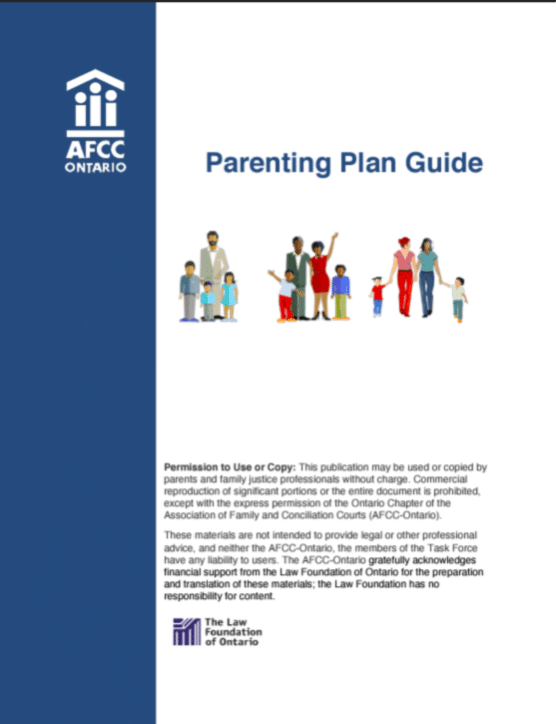
Professional help in preparing your parenting agreement
Several professionals are available to assist separating parents in preparing a parenting agreement. Here are some standard options:
In conclusion, navigating the complexities of separation and co-parenting can be a challenging journey. However, it is not a path that you have to walk alone. Numerous professionals, such as family lawyers, mediators, parenting coordinators, collaborative law professionals, and family counsellors or therapists, can provide invaluable assistance. They can guide you through the process, help you negotiate and communicate effectively, and assist in drafting a parenting agreement that prioritizes your children’s best interests.
However, ensuring that these professionals have integrated the best practices outlined in the AFCC-O Parenting Plan Guide is crucial. This guide provides a comprehensive framework for creating a parenting plan that is fair, realistic, and child-focused. By adhering to these best practices, you can transition from disappointed spouses to supportive co-parents, keeping your family’s welfare at the forefront and potentially avoiding the stress and conflict of family court.
Remember, the goal is to separate amicably and build a strong foundation for co-parenting that supports your children’s growth and well-being. You can achieve this objective with the right professional help and adherence to proven guidelines.
External Links:
- Family Dispute Resolution in Family Law – Explanation of family dispute resolution (FDR) methods like mediation and arbitration, and their benefits over court litigation.
- Child Custody and Access – Explanation of child custody and access orders, and how joint custody arrangements can be beneficially agreed upon outside of court.
- Be Prepared for Custody Cases – Advice on preparing for child custody cases, with a focus on alternative dispute resolution methods to avoid court battles.
- What You Need to Know About Child Custody Disputes in Canada – Hamilton Cahoon provides an overview of different child custody arrangements and how out-of-court agreements can be beneficial for parents.
- Who decides child custody issues? – Legal Line offers detailed information on arbitration as an alternative to court for resolving child custody and other family law matters.
- Custody Litigation – How to Have Your Child’s Opinions Heard in Court – LK Law explains the process and benefits of section 211 reports and “hear the child” reports in custody disputes, emphasizing child-centered approaches.
- Be prepared when a child custody case goes to court – Kirk Montoute Dawson LLP provides insights on alternative dispute resolution methods, including mediation and arbitration, for child custody cases.
- Resolving disputes – think about your options – Justice Canada discusses various dispute resolution options, highlighting the benefits of mediation and arbitration for resolving custody issues outside of court.
- Custody battles in Canada: Everything you need to know – Lexpert provides a thorough explanation of both judicial and extrajudicial custody battles, with a focus on the increasing preference for out-of-court settlements.
- Child Custody Statistics in Canada: Is There Gender Bias? – This article explores statistics on child custody arrangements in Canada, showing a significant number of cases settled outside of court.

Ken Maynard CDFA, Acc.FM
I assist intelligent and successful couples in navigating the Divorce Industrial Complex by crafting rapid, custom separation agreements that pave the way for a smooth transition towards a secure future. This efficient process is achieved in about four meetings, effectively sidestepping the excessive conflicts, confusion, and costs commonly linked to legal proceedings. Clients have the flexibility to collaborate with me either via video conference or in-person through a DTSW associate at any of our six Greater Toronto mediation centers, located in Aurora, Barrie, North York, Vaughan, Mississauga, and Scarborough.